
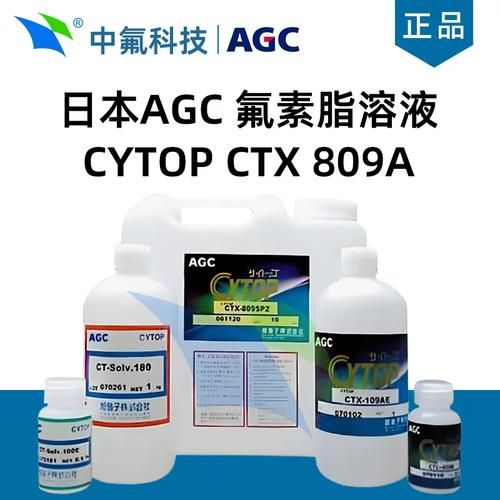
AGC Asahi Glass's CYTOP amorphous fluoropolymer is a series of high-performance materials. Its model naming is not arbitrary but follows a clear set of rules to facilitate user selection based on specific needs. Model Naming Rules: Four-Dimensional Coding System CYTOP model names include key information such as molecular weight, functional group type, solvent, and temperature. Prefix (Molecular Weight): CTL: Low molecular weight (approximately 150,000-200,000), suitable for applications requiring thinner, more uniform coatings. CTX: Standard molecular weight (approximately 250,000-300,000), generally resulting in better coating mechanical strength. CT: Basic model identifier. Middle Number (Temperature/Properties) 809: High-temperature type, maximum operating temperature 180℃. 109: Medium-temperature type, maximum operating temperature 100℃. 107: Special modified type. Suffix Letter (Functional Groups and Solvents): Functional Group Type: A: Terminal -COOH (carboxyl group), strong adhesion to glass, metal, and other substrates. M: Ended with -CONH~Si(OR)n, exhibits good adhesion to silicon-containing substrates (such as silicon wafers). S: Ended with -CF3, does not participate in chemical bonding, suitable for specific functional layers. Solvent Type: E: Represents HFE (hydrofluoroether). K: Represents HFC (hydrofluorocarbon). (No suffix): Represents PFC (perfluorocarbon).
AGC Asahi Glass's CYTOP amorphous fluoropolymer is a series of high-performance materials. Its model naming is not arbitrary but follows a clear set of rules to facilitate user selection based on specific needs.
Model Naming Rules: Four-Dimensional Coding System. CYTOP model names include key information such as molecular weight, functional group type, solvent, and temperature.
Prefix (Molecular Weight): CTL: Low molecular weight (approximately 150,000-200,000), suitable for applications requiring thinner, more uniform coatings. CTX: Standard molecular weight (approximately 250,000-300,000), generally resulting in better coating mechanical strength. CT: Basic model identifier.
Middle Number (Temperature/Properties): 809: High-temperature type, maximum operating temperature 180℃. 109: Medium-temperature type, maximum operating temperature 100℃. 107: Specially modified type.
Suffix Letter (Functional Groups and Solvents): Functional Group Type: A: Terminal -COOH (carboxyl group), strong adhesion to glass, metal, and other substrates. M: Ended with -CONH~Si(OR)n, exhibits good adhesion to silicon-containing substrates (such as silicon wafers). S: Ended with -CF3, does not participate in chemical bonding, suitable for specific functional layers.
Solvent Type: E: Represents HFE (hydrofluoroether). K: Represents HFC (hydrofluorocarbon). (No suffix): Represents PFC (perfluorocarbon).
Core Models and Specifications Overview: The following is a summary of the core parameters and typical applications of various mainstream models.
| Model | Molecular Weight | Functional Group (Type) | Maximum Temperature | Solvent | Concentration | Filtration Accuracy | Typical Applications |
|---|---|---|---|---|---|---|---|
| CTL-809A | Low | A | 180℃ | PFC | 9% | 5μm | Deep ultraviolet LED packaging, high-temperature biochips |
| CTX-809A | standard | A | 180℃ | PFC | 9% | 5μm | Automotive ADAS sensor coatings, femtosecond laser waveguides |
| CTL-109AE | Low | A | 100℃ | HFE | 9% | 5μm | Mobile phone camera anti-reflective films, microfluidic chips |
| CTX-109AE | standard | A | 100℃ | HFE | 9% | 5μm | Medical catheter coatings, flexible electronic substrates |
| CTL-809M | Low | M | 180℃ | PFC | 9% | 5μm | Nanoimprint lithography templates, semiconductor moisture-proof layers |
| CTL-107MK | Low | M | 100℃ | HFC | 7% | 5μm | Wearable device sensors, DNA electrophoresis chips |
| CTX-809SP2 | standard | S | 180℃ | PFC | 9% | 0.2μm | EUV photoresist masks, MEMS device packaging |
🔬 Key Characteristics High Transparency: Visible light transmittance >95%, UV light transmittance >90%, refractive index as low as 1.34. Excellent Electrical Insulation: Dielectric constant as low as 2.0-2.1. Water and Oil Repellency: Water contact angle up to 112°. Superior Chemical Resistance: Resistant to various acids, alkalis, and organic solvents. Solution Processable: Soluble in specialized fluorinated solvents and can be coated using various methods.
🎯 Application Areas CYTOP is widely used in high-tech fields. Optics and Displays: Anti-reflective films, optical waveguides, flexible display gate insulating films. Semiconductors and Electronics: Photomask dustproof films (Pellicle), semiconductor insulating coatings, MEMS device packaging, electret materials. Life Sciences: Biochips, medical catheter coatings, microfluidic chips. Others: Deep UV LED packaging, automotive sensor coatings, nanoimprinting.
💎 Selection Guide When choosing a CYTOP model, consider the following: Based on process temperature: If the process temperature is >120°C, choose the 809 series; if the temperature is room temperature or below 100°C, the 109 series offers better value. Based on substrate type: Choose type A for glass/metal; type M for silicon/quartz; type S for specific functional layers.
Based on coating method: Spin Coating: Use a solvent with a boiling point of 180°C (e.g., CT-SOLV180). Dip Coating: Use a solvent with a boiling point of 100°C (e.g., CT-SOLV100E/K). Spray Coating: Two solvents can be mixed.
For more detailed technical information, please visit the CYTOP™ Technical Manual download page on the AGC website.
AGC Asahi Glass's CYTOP amorphous fluoropolymer is a series of high-performance materials. Its model naming is not arbitrary but follows a clear set of rules to facilitate user selection based on specific needs. Model Naming Rules: Four-Dimensional Coding System CYTOP model names include key information such as molecular weight, functional group type, solvent, and temperature. Prefix (Molecular Weight): CTL: Low molecular weight (approximately 150,000-200,000), suitable for applications requiring thinner, more uniform coatings. CTX: Standard molecular weight (approximately 250,000-300,000), generally resulting in better coating mechanical strength. CT: Basic model identifier. Middle Number (Temperature/Properties) 809: High-temperature type, maximum operating temperature 180℃. 109: Medium-temperature type, maximum operating temperature 100℃. 107: Special modified type. Suffix Letter (Functional Groups and Solvents): Functional Group Type: A: Terminal -COOH (carboxyl group), strong adhesion to glass, metal, and other substrates. M: Ended with -CONH~Si(OR)n, exhibits good adhesion to silicon-containing substrates (such as silicon wafers). S: Ended with -CF3, does not participate in chemical bonding, suitable for specific functional layers. Solvent Type: E: Represents HFE (hydrofluoroether). K: Represents HFC (hydrofluorocarbon). (No suffix): Represents PFC (perfluorocarbon).
AGC Asahi Glass's CYTOP amorphous fluoropolymer is a series of high-performance materials. Its model naming is not arbitrary but follows a clear set of rules to facilitate user selection based on specific needs.
Model Naming Rules: Four-Dimensional Coding System. CYTOP model names include key information such as molecular weight, functional group type, solvent, and temperature.
Prefix (Molecular Weight): CTL: Low molecular weight (approximately 150,000-200,000), suitable for applications requiring thinner, more uniform coatings. CTX: Standard molecular weight (approximately 250,000-300,000), generally resulting in better coating mechanical strength. CT: Basic model identifier.
Middle Number (Temperature/Properties): 809: High-temperature type, maximum operating temperature 180℃. 109: Medium-temperature type, maximum operating temperature 100℃. 107: Specially modified type.
Suffix Letter (Functional Groups and Solvents): Functional Group Type: A: Terminal -COOH (carboxyl group), strong adhesion to glass, metal, and other substrates. M: Ended with -CONH~Si(OR)n, exhibits good adhesion to silicon-containing substrates (such as silicon wafers). S: Ended with -CF3, does not participate in chemical bonding, suitable for specific functional layers.
Solvent Type: E: Represents HFE (hydrofluoroether). K: Represents HFC (hydrofluorocarbon). (No suffix): Represents PFC (perfluorocarbon).
Core Models and Specifications Overview: The following is a summary of the core parameters and typical applications of various mainstream models.
| Model | Molecular Weight | Functional Group (Type) | Maximum Temperature | Solvent | Concentration | Filtration Accuracy | Typical Applications |
|---|---|---|---|---|---|---|---|
| CTL-809A | Low | A | 180℃ | PFC | 9% | 5μm | Deep ultraviolet LED packaging, high-temperature biochips |
| CTX-809A | standard | A | 180℃ | PFC | 9% | 5μm | Automotive ADAS sensor coatings, femtosecond laser waveguides |
| CTL-109AE | Low | A | 100℃ | HFE | 9% | 5μm | Mobile phone camera anti-reflective films, microfluidic chips |
| CTX-109AE | standard | A | 100℃ | HFE | 9% | 5μm | Medical catheter coatings, flexible electronic substrates |
| CTL-809M | Low | M | 180℃ | PFC | 9% | 5μm | Nanoimprint lithography templates, semiconductor moisture-proof layers |
| CTL-107MK | Low | M | 100℃ | HFC | 7% | 5μm | Wearable device sensors, DNA electrophoresis chips |
| CTX-809SP2 | standard | S | 180℃ | PFC | 9% | 0.2μm | EUV photoresist masks, MEMS device packaging |
🔬 Key Characteristics High Transparency: Visible light transmittance >95%, UV light transmittance >90%, refractive index as low as 1.34. Excellent Electrical Insulation: Dielectric constant as low as 2.0-2.1. Water and Oil Repellency: Water contact angle up to 112°. Superior Chemical Resistance: Resistant to various acids, alkalis, and organic solvents. Solution Processable: Soluble in specialized fluorinated solvents and can be coated using various methods.
🎯 Application Areas CYTOP is widely used in high-tech fields. Optics and Displays: Anti-reflective films, optical waveguides, flexible display gate insulating films. Semiconductors and Electronics: Photomask dustproof films (Pellicle), semiconductor insulating coatings, MEMS device packaging, electret materials. Life Sciences: Biochips, medical catheter coatings, microfluidic chips. Others: Deep UV LED packaging, automotive sensor coatings, nanoimprinting.
💎 Selection Guide When choosing a CYTOP model, consider the following: Based on process temperature: If the process temperature is >120°C, choose the 809 series; if the temperature is room temperature or below 100°C, the 109 series offers better value. Based on substrate type: Choose type A for glass/metal; type M for silicon/quartz; type S for specific functional layers.
Based on coating method: Spin Coating: Use a solvent with a boiling point of 180°C (e.g., CT-SOLV180). Dip Coating: Use a solvent with a boiling point of 100°C (e.g., CT-SOLV100E/K). Spray Coating: Two solvents can be mixed.
For more detailed technical information, please visit the CYTOP™ Technical Manual download page on the AGC website.