In 2026, the embodied AI and robotics industries experienced explosive growth. Industrial robots, collaborative robots, service robots, and humanoid robots are moving from laboratories into factories, warehouses, and homes. Capable of tasks ranging from material handling and welding to inspection and companionship, they are becoming increasingly powerful and are being deployed in a growing number of scenarios.
By 2026, the embodied AI and robotics industries have experienced explosive growth. Industrial robots, collaborative robots, service robots, and humanoid robots are transitioning from laboratories to factories, warehouses, and homes. Capable of tasks ranging from material handling and welding to inspection and companionship, their capabilities are expanding, and their deployment scenarios are multiplying.
However, the real-world deployment of robots faces a repeatedly confirmed "invisible hurdle": while robots are resilient against drops and impacts, they are highly vulnerable to moisture. Engineers long ago solved the challenges of making mechanical structures resistant to drops and vibrations; yet, protecting electronic control systems against moisture and condensation has become a frequent stumbling block for the mass production and deployment of robots.
It is not uncommon to see robots break down during the rainy season, malfunction in humid warehouses, or crash in cold-chain environments. This article explores this invisible hurdle in the deployment of embodied AI: moisture protection for electronic control systems.
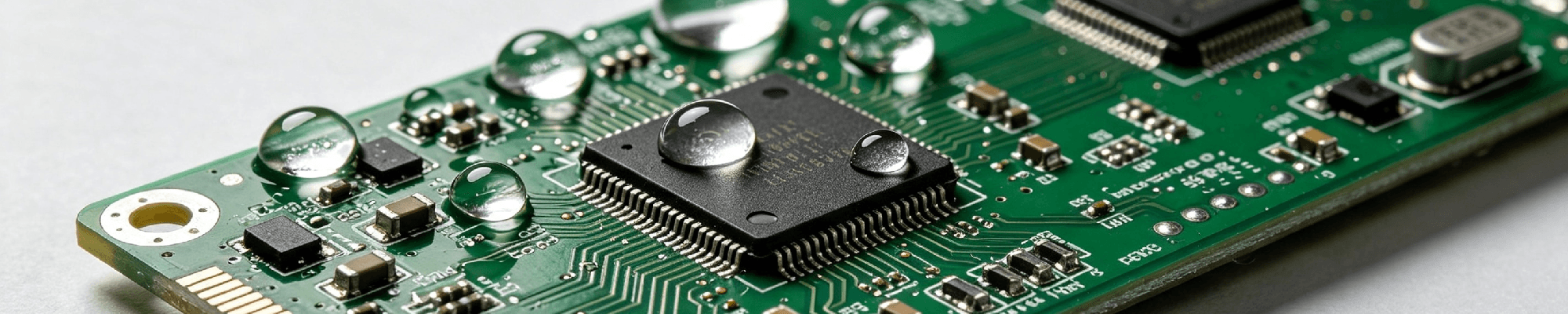
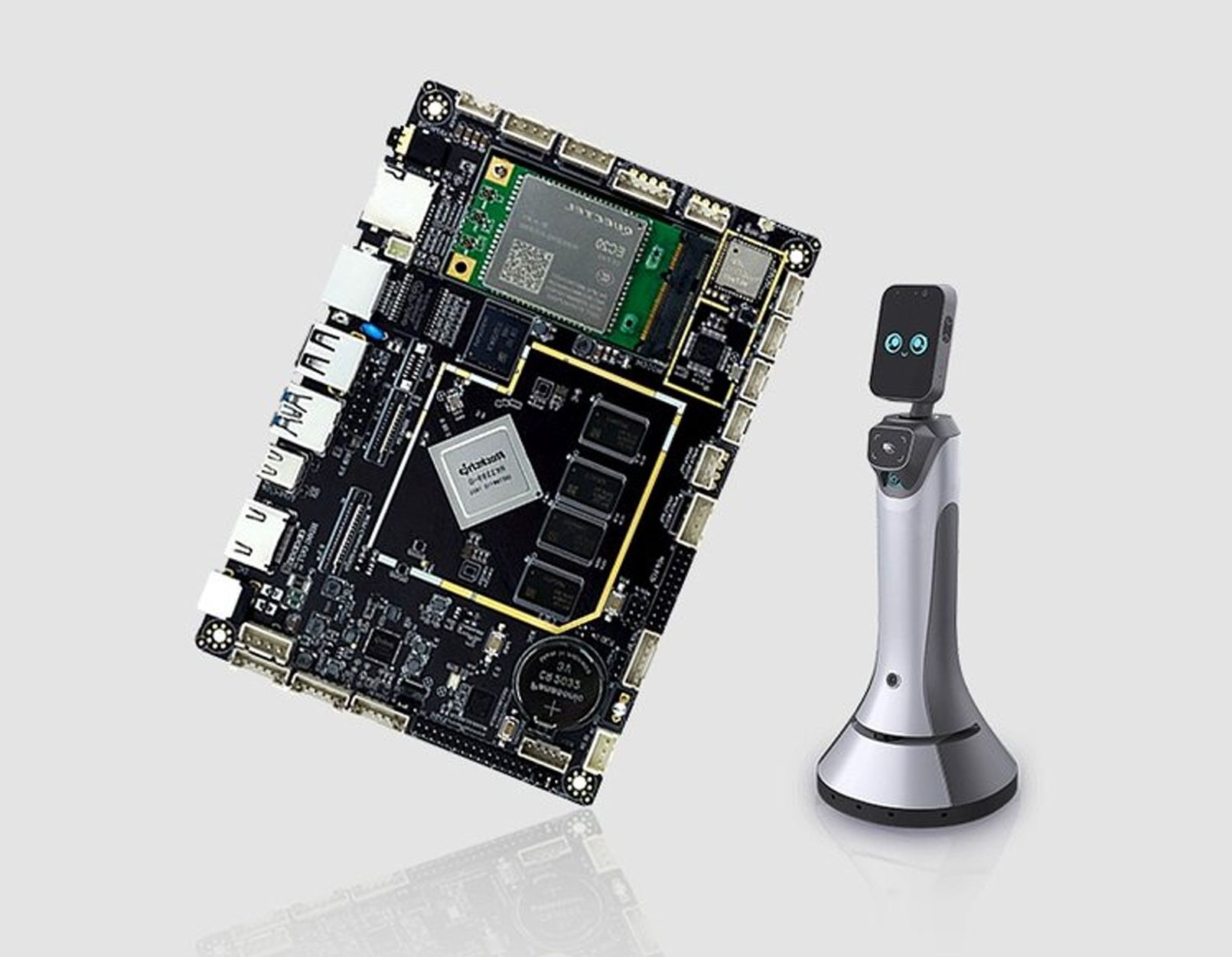
Figure 1: Electronic protection for robot control board PCBA
I. Where Does the "Moisture" Threat Come From?
Robots often operate in environments far more humid than one might imagine. Factory processes such as welding, cleaning, injection molding, and food processing generate significant water vapor and condensation. In logistics and warehousing, cold-chain facilities and damp underground warehouses maintain high humidity levels year-round. Meanwhile, outdoor inspection robots must withstand rain, dew, and salt spray.
Yet, a robot's electronic control system is precisely the component most vulnerable to moisture. The chips, solder joints, and connectors densely packed onto PCBs—including main control boards, drive boards, sensor boards, and power boards—are highly susceptible; moisture exposure can lead to anything from unstable signals and erratic behavior to short circuits, burnout, and total system failure.
Even more insidious is how the robot's own movement and heat generation exacerbate condensation. High currents in motor drives and heavy loads on main control chips raise PCB temperatures; however, when a robot transitions from active operation to standby, or moves from a warm indoor area into a cold warehouse, sudden temperature shifts trigger condensation. This cycle of "heating up during motion and becoming damp during downtime" is a classic failure mode for robotic electronic systems.
II. Why Traditional Protection Methods Fall Short
Traditionally, there have been two main approaches to protecting robotic electronics: structural sealing and protective coatings.
Structural sealing relies on housings, gaskets, and potting compounds to hermetically seal the electronics compartment. The drawbacks are obvious: increased weight and bulk (robots are extremely weight-sensitive), impaired heat dissipation (a major issue for drive boards), and difficult maintenance (disassembly is a major, disruptive undertaking). Furthermore, even the best seals cannot prevent long-term seal degradation or internal condensation caused by the "breathing effect" (pressure changes drawing in moist air).
While traditional conformal coatings offer some moisture resistance, their thickness and poor thermal conductivity clash with the "high-current, high-heat" nature of robotic drive boards. In compact areas with demanding thermal requirements—such as joint drive modules—conformal coatings often fail to balance these competing needs effectively. Robots require a protective solution that is lightweight, thin, heat-dissipation-friendly, and reworkable. This is precisely the niche filled by nano-coatings for electronic protection.
III. Nano-coatings: "Invisible Armor" for Robotic Electronic Systems
Nano-coatings for electronic protection encase a robot's PCB in an "invisible armor" layer measuring just 0.8 to 13 microns in thickness.
They are lightweight. Unlike potting compounds—which are millimeters thick and weigh tens of grams—nano-coatings add negligible weight, having no impact on a robot's movement performance or battery life. They are thin. With a thickness of 0.8 to 13 microns and thermal resistance of only 0.0057 to 0.11 K/W, they barely impede heat dissipation from drive boards—a critical factor for high-current drive applications.
They are reliable. The coating features a water contact angle of 116° to 123° and surface energy as low as 10 to 20 mN/m, making it difficult for water vapor to condense. It achieves a cross-hatch adhesion rating of 4B or higher, retains 96% adhesion after 1,000 thermal cycles (-40°C to 125°C), and withstands 1,000 hours of salt spray testing. Furthermore, the coating is rework-friendly; repairs require only localized removal and re-application.
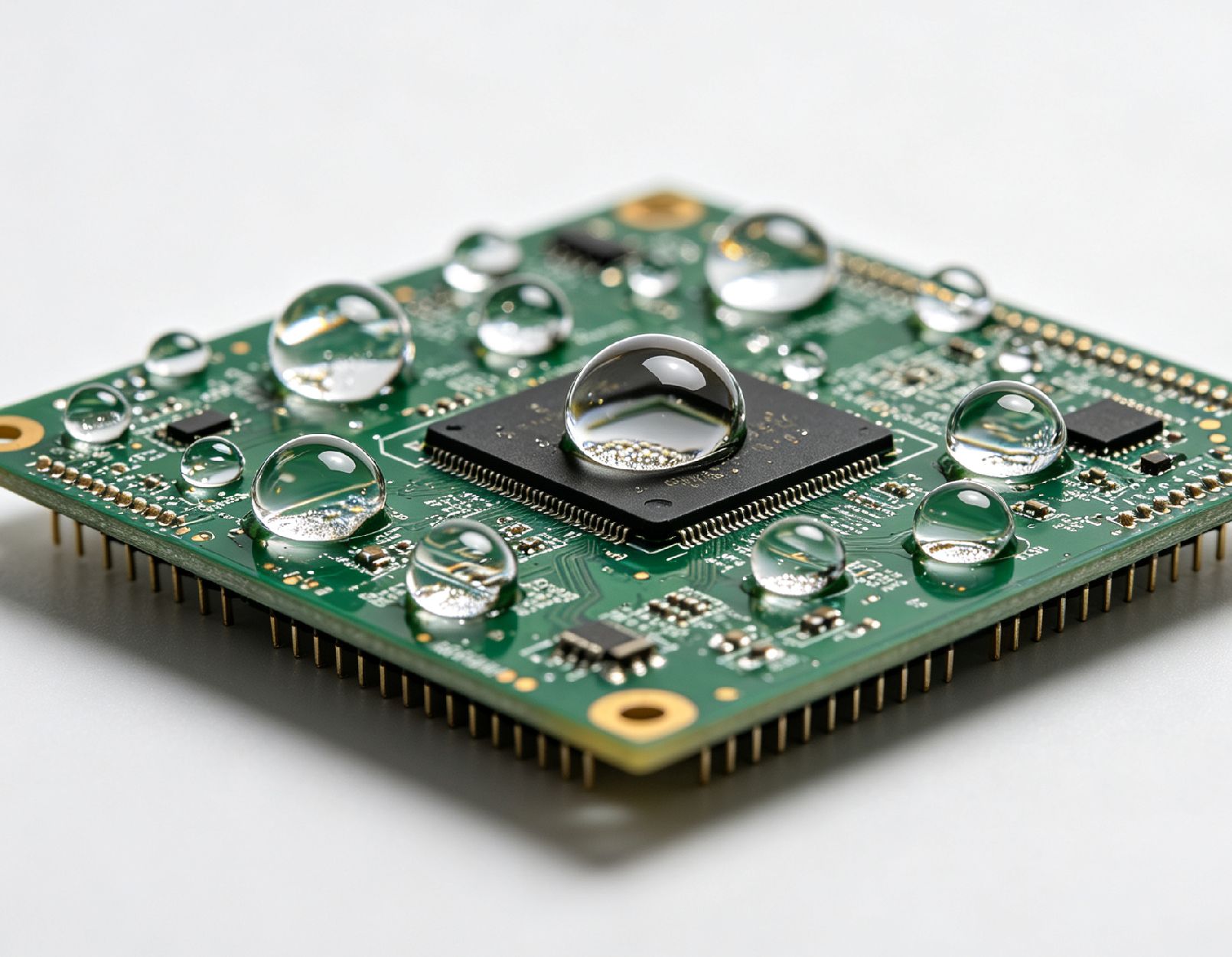
Figure 2: Hydrophobic effect of the nano-coating on a robot control board
4. From laboratory to mass production: robot protection implemented
The protection of robot products requires a systematic approach.
The first step is scene diagnosis. Find out what environment the robot works in - the heat and humidity in the welding workshop, the low temperature and high humidity in the cold chain warehouse, or the rain and salt spray outdoors. Different environments require different protection priorities and plans. The second step is plan matching. Based on the diagnostic results and PCB characteristics, select the immersion or spraying process and determine the coating model. The third step is to verify the implementation. Sample testing, small batch trial production, and stable mass production are three steps, and the protective effect is verified by tests such as salt spray, temperature cycle, and double 85.
The technical team of Sinofluoro Technology has served many customers in the fields of industrial automation and robotics. It has rich practical experience in robot electronic protection and can accompany customers throughout the entire process to ensure solid protection.
5. Three questions about robot protection
Question 1: The robot joint drive generates a lot of heat. Does the coating affect heat dissipation? No impact. With an ultra-thin thickness of 0.8 to 13 microns and extremely low thermal resistance, it is one of the most heat-friendly protection solutions.
Question 2: If the robot often collides and vibrates, will the coating fall off? Won't. The coating is chemically bonded to the substrate, has strong adhesion, and remains stable in vibration, collision, and hot and cold cycles.
Question 3: The robot requires frequent maintenance. Will the coating affect repairs? No impact. The nano-coating can be partially removed and re-coated, making it repair-friendly.
6. Fluorine-free route: Compliance choice for robot exports
A large number of robot products are exported overseas, and environmental compliance is a hard threshold. The EU's trend of restricting PFAS has made the fluorine-free route an important direction. China Fluoro Technology's 1700 series of fluorine-free super-hydrophobic electronic protective nano-coatings has self-healing properties, is intact in the salt spray test for 168 to 240 hours, and is stable in high and low temperature resistance, providing a compliant and reliable technical path for robot electronic systems.
The implementation of embodied intelligence relies not only on smart algorithms and flexible structures, but also on "non-squeamish" reliability. When a robot can withstand the test of moisture, condensation, and salt spray, it can truly enter every corner of factories, warehouses, and homes. Electronic protective nanocoating agents use molecular-level protection to clear the invisible threshold for the implementation of embodied intelligence. Robots are not afraid of falling, and they should not be afraid of tides. Choosing the right protection is to add a reliable insurance for every stable operation of the robot.
The explosion of embodied intelligence is pushing robots into broader implementation scenarios. Humanoid robots have entered factories, warehousing, and homes, service robots have shuttled around restaurants, hotels, and hospitals, and special robots have penetrated into high-risk, high-humidity, and harsh environments. These scenarios all place higher requirements on the environmental adaptability of robots. A key part of environmental adaptability is the moisture protection of electronic systems.
A cruel reality is that many robot projects perform perfectly in the laboratory, but fail frequently when they arrive in real scenes. The root cause is often not the algorithm and structure, but the environmental failure of the electronic system. Moisture corrodes solder joints, condensation causes short circuits, and salt spray corrodes pins—these seemingly minor damages will turn into huge reliability costs when robots are mass-produced and implemented on a large scale. Electronic protection nano-coating agents use molecular-level protection to solve these problems from the source, making robots truly reliable "out of the laboratory." This is a key step for embodied intelligence to move from demonstration to mass production.
From the perspective of industry rules, competition in the robot industry will eventually shift from "ability to run through demonstrations" to "ability to stabilize mass production." The biggest test of mass production is not how smart the algorithm is, but how solid the product is in the real environment. Humidity, condensation, salt spray, and temperature differences, these factors that are easily overlooked in the laboratory, are precisely the biggest obstacles on the road to mass production. Electronic protection nano-coating agents have helped robot manufacturers remove this roadblock with proven hydrophobic, salt spray resistance, and temperature cycle resistance properties.
It is foreseeable that as embodied intelligence moves from concept to implementation, and from prototypes to mass production, device-level nano-protection will become a standard component for robot reliability, just like motors, reducers, and sensors. Those manufacturers that have implemented solid protection early will take the lead in this round of industrial explosion and move forward more steadily and further.
For robot manufacturers, the choice of protection solutions is essentially a reflection of product positioning. Brands that position themselves as high-end and pursue reputation often put reliability first and take electronic protection into consideration from the beginning of the design. And those brands that are eager to increase volume and ignore protection will eventually pay the price in after-sales costs and user reputation. Electronic protection nano-coating agents provide reliable technical support for manufacturers that are serious about making products and brands.
Behind every stable operation of the robot is the collaboration of countless links. Electronic protection is a low-key but critical part of it. When an invisible coating silently protects the robot's control board, the robot can truly be "not afraid of moisture and not squeamish" and steadily move towards mass production and implementation in the vast real world.
In 2026, the embodied AI and robotics industries experienced explosive growth. Industrial robots, collaborative robots, service robots, and humanoid robots are moving from laboratories into factories, warehouses, and homes. Capable of tasks ranging from material handling and welding to inspection and companionship, they are becoming increasingly powerful and are being deployed in a growing number of scenarios.
By 2026, the embodied AI and robotics industries have experienced explosive growth. Industrial robots, collaborative robots, service robots, and humanoid robots are transitioning from laboratories to factories, warehouses, and homes. Capable of tasks ranging from material handling and welding to inspection and companionship, their capabilities are expanding, and their deployment scenarios are multiplying.
However, the real-world deployment of robots faces a repeatedly confirmed "invisible hurdle": while robots are resilient against drops and impacts, they are highly vulnerable to moisture. Engineers long ago solved the challenges of making mechanical structures resistant to drops and vibrations; yet, protecting electronic control systems against moisture and condensation has become a frequent stumbling block for the mass production and deployment of robots.
It is not uncommon to see robots break down during the rainy season, malfunction in humid warehouses, or crash in cold-chain environments. This article explores this invisible hurdle in the deployment of embodied AI: moisture protection for electronic control systems.
Figure 1: Electronic protection for robot control board PCBA
I. Where Does the "Moisture" Threat Come From?
Robots often operate in environments far more humid than one might imagine. Factory processes such as welding, cleaning, injection molding, and food processing generate significant water vapor and condensation. In logistics and warehousing, cold-chain facilities and damp underground warehouses maintain high humidity levels year-round. Meanwhile, outdoor inspection robots must withstand rain, dew, and salt spray.
Yet, a robot's electronic control system is precisely the component most vulnerable to moisture. The chips, solder joints, and connectors densely packed onto PCBs—including main control boards, drive boards, sensor boards, and power boards—are highly susceptible; moisture exposure can lead to anything from unstable signals and erratic behavior to short circuits, burnout, and total system failure.
Even more insidious is how the robot's own movement and heat generation exacerbate condensation. High currents in motor drives and heavy loads on main control chips raise PCB temperatures; however, when a robot transitions from active operation to standby, or moves from a warm indoor area into a cold warehouse, sudden temperature shifts trigger condensation. This cycle of "heating up during motion and becoming damp during downtime" is a classic failure mode for robotic electronic systems.
II. Why Traditional Protection Methods Fall Short
Traditionally, there have been two main approaches to protecting robotic electronics: structural sealing and protective coatings.
Structural sealing relies on housings, gaskets, and potting compounds to hermetically seal the electronics compartment. The drawbacks are obvious: increased weight and bulk (robots are extremely weight-sensitive), impaired heat dissipation (a major issue for drive boards), and difficult maintenance (disassembly is a major, disruptive undertaking). Furthermore, even the best seals cannot prevent long-term seal degradation or internal condensation caused by the "breathing effect" (pressure changes drawing in moist air).
While traditional conformal coatings offer some moisture resistance, their thickness and poor thermal conductivity clash with the "high-current, high-heat" nature of robotic drive boards. In compact areas with demanding thermal requirements—such as joint drive modules—conformal coatings often fail to balance these competing needs effectively. Robots require a protective solution that is lightweight, thin, heat-dissipation-friendly, and reworkable. This is precisely the niche filled by nano-coatings for electronic protection.
III. Nano-coatings: "Invisible Armor" for Robotic Electronic Systems
Nano-coatings for electronic protection encase a robot's PCB in an "invisible armor" layer measuring just 0.8 to 13 microns in thickness.
They are lightweight. Unlike potting compounds—which are millimeters thick and weigh tens of grams—nano-coatings add negligible weight, having no impact on a robot's movement performance or battery life. They are thin. With a thickness of 0.8 to 13 microns and thermal resistance of only 0.0057 to 0.11 K/W, they barely impede heat dissipation from drive boards—a critical factor for high-current drive applications.
They are reliable. The coating features a water contact angle of 116° to 123° and surface energy as low as 10 to 20 mN/m, making it difficult for water vapor to condense. It achieves a cross-hatch adhesion rating of 4B or higher, retains 96% adhesion after 1,000 thermal cycles (-40°C to 125°C), and withstands 1,000 hours of salt spray testing. Furthermore, the coating is rework-friendly; repairs require only localized removal and re-application.
Figure 2: Hydrophobic effect of the nano-coating on a robot control board
4. From laboratory to mass production: robot protection implemented
The protection of robot products requires a systematic approach.
The first step is scene diagnosis. Find out what environment the robot works in - the heat and humidity in the welding workshop, the low temperature and high humidity in the cold chain warehouse, or the rain and salt spray outdoors. Different environments require different protection priorities and plans. The second step is plan matching. Based on the diagnostic results and PCB characteristics, select the immersion or spraying process and determine the coating model. The third step is to verify the implementation. Sample testing, small batch trial production, and stable mass production are three steps, and the protective effect is verified by tests such as salt spray, temperature cycle, and double 85.
The technical team of Sinofluoro Technology has served many customers in the fields of industrial automation and robotics. It has rich practical experience in robot electronic protection and can accompany customers throughout the entire process to ensure solid protection.
5. Three questions about robot protection
Question 1: The robot joint drive generates a lot of heat. Does the coating affect heat dissipation? No impact. With an ultra-thin thickness of 0.8 to 13 microns and extremely low thermal resistance, it is one of the most heat-friendly protection solutions.
Question 2: If the robot often collides and vibrates, will the coating fall off? Won't. The coating is chemically bonded to the substrate, has strong adhesion, and remains stable in vibration, collision, and hot and cold cycles.
Question 3: The robot requires frequent maintenance. Will the coating affect repairs? No impact. The nano-coating can be partially removed and re-coated, making it repair-friendly.
6. Fluorine-free route: Compliance choice for robot exports
A large number of robot products are exported overseas, and environmental compliance is a hard threshold. The EU's trend of restricting PFAS has made the fluorine-free route an important direction. China Fluoro Technology's 1700 series of fluorine-free super-hydrophobic electronic protective nano-coatings has self-healing properties, is intact in the salt spray test for 168 to 240 hours, and is stable in high and low temperature resistance, providing a compliant and reliable technical path for robot electronic systems.
The implementation of embodied intelligence relies not only on smart algorithms and flexible structures, but also on "non-squeamish" reliability. When a robot can withstand the test of moisture, condensation, and salt spray, it can truly enter every corner of factories, warehouses, and homes. Electronic protective nanocoating agents use molecular-level protection to clear the invisible threshold for the implementation of embodied intelligence. Robots are not afraid of falling, and they should not be afraid of tides. Choosing the right protection is to add a reliable insurance for every stable operation of the robot.
The explosion of embodied intelligence is pushing robots into broader implementation scenarios. Humanoid robots have entered factories, warehousing, and homes, service robots have shuttled around restaurants, hotels, and hospitals, and special robots have penetrated into high-risk, high-humidity, and harsh environments. These scenarios all place higher requirements on the environmental adaptability of robots. A key part of environmental adaptability is the moisture protection of electronic systems.
A cruel reality is that many robot projects perform perfectly in the laboratory, but fail frequently when they arrive in real scenes. The root cause is often not the algorithm and structure, but the environmental failure of the electronic system. Moisture corrodes solder joints, condensation causes short circuits, and salt spray corrodes pins—these seemingly minor damages will turn into huge reliability costs when robots are mass-produced and implemented on a large scale. Electronic protection nano-coating agents use molecular-level protection to solve these problems from the source, making robots truly reliable "out of the laboratory." This is a key step for embodied intelligence to move from demonstration to mass production.
From the perspective of industry rules, competition in the robot industry will eventually shift from "ability to run through demonstrations" to "ability to stabilize mass production." The biggest test of mass production is not how smart the algorithm is, but how solid the product is in the real environment. Humidity, condensation, salt spray, and temperature differences, these factors that are easily overlooked in the laboratory, are precisely the biggest obstacles on the road to mass production. Electronic protection nano-coating agents have helped robot manufacturers remove this roadblock with proven hydrophobic, salt spray resistance, and temperature cycle resistance properties.
It is foreseeable that as embodied intelligence moves from concept to implementation, and from prototypes to mass production, device-level nano-protection will become a standard component for robot reliability, just like motors, reducers, and sensors. Those manufacturers that have implemented solid protection early will take the lead in this round of industrial explosion and move forward more steadily and further.
For robot manufacturers, the choice of protection solutions is essentially a reflection of product positioning. Brands that position themselves as high-end and pursue reputation often put reliability first and take electronic protection into consideration from the beginning of the design. And those brands that are eager to increase volume and ignore protection will eventually pay the price in after-sales costs and user reputation. Electronic protection nano-coating agents provide reliable technical support for manufacturers that are serious about making products and brands.
Behind every stable operation of the robot is the collaboration of countless links. Electronic protection is a low-key but critical part of it. When an invisible coating silently protects the robot's control board, the robot can truly be "not afraid of moisture and not squeamish" and steadily move towards mass production and implementation in the vast real world.