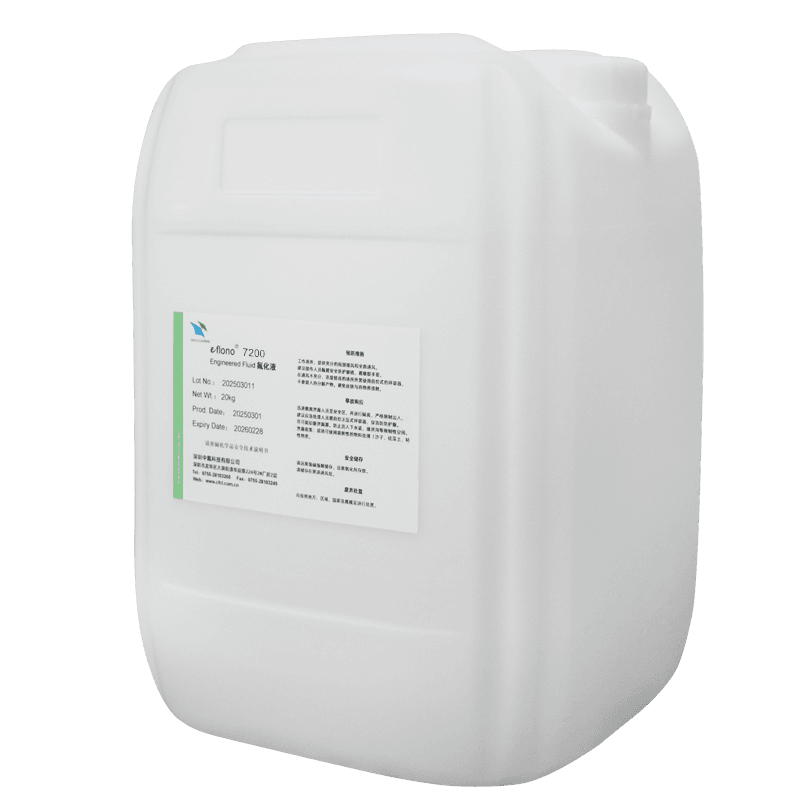
Fluoropolymers are a class of polymeric materials characterized by a backbone of carbon-fluorine (C-F) bonds. Thanks to their extremely low surface energy, excellent chemical inertness, and superior electrical insulation properties, they can serve as electronic fluorinated fluids for data center immersion cooling and precision cleaning, or be formulated into fluorocarbon coatings that provide long-lasting corrosion resistance and non-stick protection.
Fluoropolymers are a class of macromolecular materials characterized by a backbone of carbon-fluorine (C-F) bonds. Thanks to their extremely low surface energy, excellent chemical inertness, and superior electrical insulation properties, they can be used as fluorinated electronic fluids for data center immersion cooling and precision cleaning, or formulated into fluorocarbon coatings that provide long-lasting corrosion resistance and non-stick protection.
I. What are fluoropolymers?
Fluoropolymers are alkane-based polymers in which some or all of the hydrogen atoms have been replaced by fluorine. The carbon-fluorine bond is one of the strongest single bonds in organic chemistry (with a bond energy of approximately 485 kJ/mol); this structural feature imparts exceptional thermal stability, chemical inertness, and extremely low surface energy to the material.
Common types include:
| Variety | full name | Continuous use temperature | Density (g/cm³) | Dielectric constant | Core features |
|---|---|---|---|---|---|
| PTFE | Polytetrafluoroethylene | 260℃-1 | 2.13-2.19- | 2.1- | Excellent chemical resistance, lowest coefficient of friction |
| PFA | Melt-processable polytetrafluoroethylene | 260℃-1 | 2.13-2.16-2 | 2.1 | Melt-processable, chemical resistance comparable to PTFE |
| FEP | Fluorinated ethylene propylene copolymer | 205℃-1 | 2.15-2 | 2.1-2 | Melt-processable, good transparency |
| ETFE | Ethylene-tetrafluoroethylene copolymer | 155℃-1 | 1.70-1.76 | 2.6 | High mechanical strength, excellent wear resistance |
Fluoropolymers are virtually impervious to chemical attack; after immersion in water for 24 hours at room temperature followed by boiling for 2 hours, their moisture absorption rate is less than 0.03%. They possess a high oxygen index, and PTFE, PFA, and FEP all meet the UL 94 V-0 flame retardancy rating.
II. Why are fluoropolymers suitable as agents for cleaning, cooling, and heat transfer?
2.1 Core Principle: The "Three-Non" Characteristics Conferred by C-F Bonds
The ability of electronic fluorinated fluids—made from fluoropolymers—to simultaneously perform cleaning, cooling, and heat transfer functions stems from three key characteristics of their molecular structure:
Non-conductive: They have a low dielectric constant (approx. 1.8–2.1) and a volume resistivity exceeding 10¹⁵ Ω·cm, allowing direct contact with live electronic components without causing short circuits.
Non-reactive: They exhibit extreme chemical inertness, do not react with metals, plastics, or rubber, and do not corrode equipment.
Non-flammable: They have no flash point and do not spontaneously combust, significantly reducing fire risks in data centers.
2.2 How do they facilitate heat transfer and cooling?
Electronic fluorinated fluids achieve efficient heat dissipation either by absorbing heat through the liquid's specific heat capacity (single-phase) or by absorbing the latent heat of vaporization during a liquid-to-gas phase change (two-phase).
Single-phase immersion cooling: The fluorinated fluid remains in the liquid phase; electronic components are directly submerged in the dielectric liquid, and heat transferred to the liquid is pumped to a heat exchanger for cooling. This method is suitable for high-boiling-point fluorinated fluids (120–150°C).
Two-phase immersion cooling: This method utilizes the boiling and condensation processes of low-boiling-point (60–80°C) fluorinated fluids to exponentially increase heat transfer efficiency. Vapor rises to a condenser to revert to liquid, eliminating the need for a circulation pump.
Thermal conductivity ranges from 0.06 to 0.08 W/m·K, and the phase-change temperature range is precisely matched to chip operating temperatures, meeting the precise heat dissipation requirements for AI chips with power outputs exceeding 300W. 2.3 Why is it effective for cleaning?
Fluorinated fluids were originally developed as circuit board cleaning agents for the electronics manufacturing industry. Their low surface tension (e.g., 13.6 mN/m for 3M Novec 7200) allows them to penetrate tight spaces and effectively remove oil, flux residues, and dust. Furthermore, because they are non-conductive, they enable "live" cleaning—meaning communication base stations and low-voltage equipment cabinets can be cleaned without powering down.
2.4 Key parameters of electronic fluorinated fluids (essential for data center selection)
| Parameter | Typical Value | Description |
|---|---|---|
| Dielectric strength | >25 kV(2.5mm)>55 kV- | Insulation class: higher means safer |
| Volume resistivity | ≥1×10¹⁵ Ω·cm- | Key indicator of insulation performance |
| Dielectric constant | 1.85-2.1- | Lower values mean less signal loss |
| Boiling point | 40℃-165℃- | Choose high boiling point for single-phase; low boiling point for two-phase |
| Global Warming Potential (GWP) | 3M Novec 7200-57 | Environmental indicator: lower is better |
| Kinematic viscosity | 0.4 mPa·s(23℃) | Lower values mean better fluidity |
2.5 How to Select Fluorinated Fluids for Data Centers? (Four-Step Selection Method)
Step 1: Determine the cooling architecture
Cold-plate liquid cooling: Uses low-conductivity water-glycol mixtures-
Immersion liquid cooling: Uses fluorinated fluids—the focus of this article-
Step 2: Determine single-phase vs. two-phase
Single-phase immersion: Select a fluorinated fluid with a boiling point of 120–150°C; maintains liquid-state circulation-
Two-phase immersion: Select a fluorinated fluid with a boiling point of 60–80°C; utilizes phase-change heat absorption-
Step 3: Verify insulation and compatibility
Dielectric strength ≥ 25 kV (2.5 mm gap)-
Volume resistivity ≥ 10¹⁵ Ω·cm-
Compatible with server materials (PCBs, seals, cables); no swelling occurs
Step 4: Evaluate environmental impact and cost
ODP = 0 (zero ozone depletion potential)
Lower GWP (Global Warming Potential) is preferable-
Hydrofluoroethers (HFEs) cost 30%–50% less than perfluorinated compounds-
2.6 How to Set Up Fluorinated Fluid Systems in Data Centers? (Six-Step Deployment Method)
Assess heat dissipation requirements: Calculate power per rack (kW/rack); choose low-viscosity HFEs for 5–15 kW, and high-boiling-point perfluorinated compounds for 30–50 kW-
Select fluorinated fluid: Determine boiling point, viscosity, and dielectric strength based on phase type (single/two-phase) and power-
Design liquid cooling cabinet: Sealed tank, circulation pump (required for single-phase), condenser (required for two-phase)
Material compatibility testing: Immerse server materials (PCBs, seals, cables) in the fluorinated fluid for 48 hours to confirm no swelling or corrosion
Filling and commissioning: Inject fluorinated fluid, start circulation/temperature control systems, and monitor temperature distribution
O&M monitoring: Regularly test the fluid's dielectric strength, moisture content, and acid value
2.7 What is single-phase? What is two-phase? Single-Phase: The coolant remains in a liquid state throughout; it absorbs heat based on the liquid's specific heat capacity and dissipates heat through forced circulation driven by a pump. It features a simple structure with no leakage losses and is suitable for low- to medium-density server cabinets.
Two-Phase: The coolant undergoes a liquid-to-gas phase change, absorbing large amounts of heat via the latent heat of vaporization, with the vapor condensing and flowing back. Heat transfer efficiency is exponentially higher, and no circulation pump is required; this method is suitable for ultra-high-density server cabinets exceeding 50 kW.
2.8 Corresponding Product Models and Pricing
| Product Model | Type | Boiling Point | Typical Applications | Reference Price |
|---|---|---|---|---|
| 3M Novec 7200 | Hydrofluoroether | 76°C-11 | Precision cleaning, single/two-phase cooling | Approx. 3,107 Yuan per 15 kg drum |
| CXF-160 | Perfluoroether | 160°C+ | Single-phase immersion liquid cooling | Contact the manufacturer for details |
| KEY-117MAX | Hydrofluoroether (benchmark: Novec 7200) | 76°C | Data center cooling and cleaning | Contact the manufacturer for details |
| Fluere-3100 | Fluorinated Liquid | — | Immersion Phase-Change Liquid Cooling for Servers | Contact the manufacturer for details |
3. Why are fluoropolymers suitable for protective coatings?
3.1 Core Principles: Extremely Low Surface Energy + Chemical Inertness
The protective capability of fluoropolymer coatings stems from two primary mechanisms:
Physical Barrier: The C-F bond imparts extremely low surface energy, making it difficult for liquids to wet the coating surface. The water contact angle can exceed 104.5°, and the dynamic friction coefficient can be as low as 0.05–0.20.
Chemical Barrier: Fluoropolymers exhibit broad resistance to acids, alkalis, and solvents, remaining virtually unaffected by chemical corrosion.
3.2 Why do they provide corrosion protection?
Fluorocarbon coatings form a dense physical barrier that prevents water vapor, oxygen, and corrosive media from contacting the substrate.
After a 720-hour neutral salt spray test, epoxy/fluorocarbon composite coatings show no pitting, blistering, or cracking; pencil hardness remains at 4H, and adhesion stays above 5 MPa.
Fluorocarbon resin coatings remain intact after a 1,500-hour neutral salt spray test, with wet adhesion reaching 3.52 MPa.
Fluorocarbon coatings for steel structures offer weather resistance of up to 20 years and salt spray resistance of 1,000 hours.
3.3 Why are they non-stick?
Fluoropolymers have extremely low surface energy, meaning almost no solid substance can adhere permanently. Even if sticky materials adhere temporarily, they are easily removed. This characteristic makes them the top choice for non-stick cookware coatings and widely applicable for anti-stick and anti-fouling purposes in chemical processing equipment.
3.4 Key parameters for coating protection
| Parameters | PTFE coating | FEP coating | ETFE coating | Fluorocarbon coating (FEVE) |
|---|---|---|---|---|
| Continuous service temperature | 260℃ | 200℃ | 150℃-1 | -40℃~150℃- |
| Coating thickness | <100 μm | >1000 μm | 75-250 μm- | 40 μm- |
| Coefficient of friction | 0.05-0.20- | 0.05-0.20 | — | — |
| Salt spray resistance | — | — | — | 1000-3000小时- |
| Weather resistance | Excellent | Excellent | Excellent | Over 20 years - |
| Application Scenarios | Recommended Coatings | Key Features |
|---|---|---|
| Anti-corrosion linings and piping for the chemical industry | PTFE/PFA | Superior chemical resistance; suitable for continuous use at 260°C |
| Semiconductor air ducts and wafer carriers | FEP | Melt-processable; enables uniform thick coatings; meets rigorous semiconductor industry standards |
| Non-stick cookware | PTFE/FEP- | Ultra-low surface energy; food-contact certified |
| Architectural membrane materials and wear-resistant coatings | ETFE- | High mechanical strength and toughness |
| Anti-corrosion topcoats for bridges and steel structures | Fluorocarbon Coating (FEVE) | Exceptional weather resistance and self-cleaning properties; 20-year service life |
| Brand/Series | Type | Typical Applications |
|---|---|---|
| Chemours Teflon™ PTFE/FEP/PFA | Fluoropolymer Coatings | Chemical Corrosion Protection, Non-stick Coatings, Semiconductor Applications |
| Daikin POLYFLON PTFE | PTFE Resin | Sealing, Lining, Insulation |
| Daikin NEOFLON FEP/PFA | Melt-processable resins | Wire coating, pipe and valve lining |
| Hengfulong™ FEP D50 | Water-based dispersion | Non-stick coatings, anti-corrosion coatings- |
| Comparison Item | Electronic Fluorinated Fluid | Water/Glycol | Mineral Oil |
|---|---|---|---|
| Electrical insulation | Excellent (dielectric strength >25 kV) | Poor (conductive; risk of short circuit) | Good |
| Non-combustible | Non-combustible | Non-combustible | flammable |
| Material Compatibility | Excellent (inert, non-corrosive) | Fair (metal corrosion) | Fair (may cause seal swelling) |
| Heat transfer efficiency | High (0.06–0.08 W/m·K) | High | Moderate |
| Maintenance costs | Moderate | Low | Low |
| Application Scenarios | High-power chips, immersion liquid cooling | Cold plate, indirect cooling | Transformer cooling |
5. Summary
Relying on the chemical inertness, thermal stability and extremely low surface energy endowed by carbon-fluorine bonds, fluoropolymers have shown irreplaceable value in two major areas:
As an electronic fluorinated fluid: taking advantage of the three characteristics of non-conductivity, non-flammability, and chemical inertness, it has become the preferred medium for immersion liquid cooling (single-phase/double-phase) and precision electrified cleaning in data centers.
As a coating material: Utilizing extremely low surface energy and chemical barriers to provide long-lasting anti-corrosion, non-stick and insulating protection for metals, ceramics and other substrates
From 5G base stations in Shenzhen to super-large data centers in Guizhou, from chemical pipe valves to aerospace skins, fluoropolymers are defining the boundaries of high-performance materials.
Fluoropolymers are a class of polymeric materials characterized by a backbone of carbon-fluorine (C-F) bonds. Thanks to their extremely low surface energy, excellent chemical inertness, and superior electrical insulation properties, they can serve as electronic fluorinated fluids for data center immersion cooling and precision cleaning, or be formulated into fluorocarbon coatings that provide long-lasting corrosion resistance and non-stick protection.
Fluoropolymers are a class of macromolecular materials characterized by a backbone of carbon-fluorine (C-F) bonds. Thanks to their extremely low surface energy, excellent chemical inertness, and superior electrical insulation properties, they can be used as fluorinated electronic fluids for data center immersion cooling and precision cleaning, or formulated into fluorocarbon coatings that provide long-lasting corrosion resistance and non-stick protection.
I. What are fluoropolymers?
Fluoropolymers are alkane-based polymers in which some or all of the hydrogen atoms have been replaced by fluorine. The carbon-fluorine bond is one of the strongest single bonds in organic chemistry (with a bond energy of approximately 485 kJ/mol); this structural feature imparts exceptional thermal stability, chemical inertness, and extremely low surface energy to the material.
Common types include:
| Variety | full name | Continuous use temperature | Density (g/cm³) | Dielectric constant | Core features |
|---|---|---|---|---|---|
| PTFE | Polytetrafluoroethylene | 260℃-1 | 2.13-2.19- | 2.1- | Excellent chemical resistance, lowest coefficient of friction |
| PFA | Melt-processable polytetrafluoroethylene | 260℃-1 | 2.13-2.16-2 | 2.1 | Melt-processable, chemical resistance comparable to PTFE |
| FEP | Fluorinated ethylene propylene copolymer | 205℃-1 | 2.15-2 | 2.1-2 | Melt-processable, good transparency |
| ETFE | Ethylene-tetrafluoroethylene copolymer | 155℃-1 | 1.70-1.76 | 2.6 | High mechanical strength, excellent wear resistance |
Fluoropolymers are virtually impervious to chemical attack; after immersion in water for 24 hours at room temperature followed by boiling for 2 hours, their moisture absorption rate is less than 0.03%. They possess a high oxygen index, and PTFE, PFA, and FEP all meet the UL 94 V-0 flame retardancy rating.
II. Why are fluoropolymers suitable as agents for cleaning, cooling, and heat transfer?
2.1 Core Principle: The "Three-Non" Characteristics Conferred by C-F Bonds
The ability of electronic fluorinated fluids—made from fluoropolymers—to simultaneously perform cleaning, cooling, and heat transfer functions stems from three key characteristics of their molecular structure:
Non-conductive: They have a low dielectric constant (approx. 1.8–2.1) and a volume resistivity exceeding 10¹⁵ Ω·cm, allowing direct contact with live electronic components without causing short circuits.
Non-reactive: They exhibit extreme chemical inertness, do not react with metals, plastics, or rubber, and do not corrode equipment.
Non-flammable: They have no flash point and do not spontaneously combust, significantly reducing fire risks in data centers.
2.2 How do they facilitate heat transfer and cooling?
Electronic fluorinated fluids achieve efficient heat dissipation either by absorbing heat through the liquid's specific heat capacity (single-phase) or by absorbing the latent heat of vaporization during a liquid-to-gas phase change (two-phase).
Single-phase immersion cooling: The fluorinated fluid remains in the liquid phase; electronic components are directly submerged in the dielectric liquid, and heat transferred to the liquid is pumped to a heat exchanger for cooling. This method is suitable for high-boiling-point fluorinated fluids (120–150°C).
Two-phase immersion cooling: This method utilizes the boiling and condensation processes of low-boiling-point (60–80°C) fluorinated fluids to exponentially increase heat transfer efficiency. Vapor rises to a condenser to revert to liquid, eliminating the need for a circulation pump.
Thermal conductivity ranges from 0.06 to 0.08 W/m·K, and the phase-change temperature range is precisely matched to chip operating temperatures, meeting the precise heat dissipation requirements for AI chips with power outputs exceeding 300W. 2.3 Why is it effective for cleaning?
Fluorinated fluids were originally developed as circuit board cleaning agents for the electronics manufacturing industry. Their low surface tension (e.g., 13.6 mN/m for 3M Novec 7200) allows them to penetrate tight spaces and effectively remove oil, flux residues, and dust. Furthermore, because they are non-conductive, they enable "live" cleaning—meaning communication base stations and low-voltage equipment cabinets can be cleaned without powering down.
2.4 Key parameters of electronic fluorinated fluids (essential for data center selection)
| Parameter | Typical Value | Description |
|---|---|---|
| Dielectric strength | >25 kV(2.5mm)>55 kV- | Insulation class: higher means safer |
| Volume resistivity | ≥1×10¹⁵ Ω·cm- | Key indicator of insulation performance |
| Dielectric constant | 1.85-2.1- | Lower values mean less signal loss |
| Boiling point | 40℃-165℃- | Choose high boiling point for single-phase; low boiling point for two-phase |
| Global Warming Potential (GWP) | 3M Novec 7200-57 | Environmental indicator: lower is better |
| Kinematic viscosity | 0.4 mPa·s(23℃) | Lower values mean better fluidity |
2.5 How to Select Fluorinated Fluids for Data Centers? (Four-Step Selection Method)
Step 1: Determine the cooling architecture
Cold-plate liquid cooling: Uses low-conductivity water-glycol mixtures-
Immersion liquid cooling: Uses fluorinated fluids—the focus of this article-
Step 2: Determine single-phase vs. two-phase
Single-phase immersion: Select a fluorinated fluid with a boiling point of 120–150°C; maintains liquid-state circulation-
Two-phase immersion: Select a fluorinated fluid with a boiling point of 60–80°C; utilizes phase-change heat absorption-
Step 3: Verify insulation and compatibility
Dielectric strength ≥ 25 kV (2.5 mm gap)-
Volume resistivity ≥ 10¹⁵ Ω·cm-
Compatible with server materials (PCBs, seals, cables); no swelling occurs
Step 4: Evaluate environmental impact and cost
ODP = 0 (zero ozone depletion potential)
Lower GWP (Global Warming Potential) is preferable-
Hydrofluoroethers (HFEs) cost 30%–50% less than perfluorinated compounds-
2.6 How to Set Up Fluorinated Fluid Systems in Data Centers? (Six-Step Deployment Method)
Assess heat dissipation requirements: Calculate power per rack (kW/rack); choose low-viscosity HFEs for 5–15 kW, and high-boiling-point perfluorinated compounds for 30–50 kW-
Select fluorinated fluid: Determine boiling point, viscosity, and dielectric strength based on phase type (single/two-phase) and power-
Design liquid cooling cabinet: Sealed tank, circulation pump (required for single-phase), condenser (required for two-phase)
Material compatibility testing: Immerse server materials (PCBs, seals, cables) in the fluorinated fluid for 48 hours to confirm no swelling or corrosion
Filling and commissioning: Inject fluorinated fluid, start circulation/temperature control systems, and monitor temperature distribution
O&M monitoring: Regularly test the fluid's dielectric strength, moisture content, and acid value
2.7 What is single-phase? What is two-phase? Single-Phase: The coolant remains in a liquid state throughout; it absorbs heat based on the liquid's specific heat capacity and dissipates heat through forced circulation driven by a pump. It features a simple structure with no leakage losses and is suitable for low- to medium-density server cabinets.
Two-Phase: The coolant undergoes a liquid-to-gas phase change, absorbing large amounts of heat via the latent heat of vaporization, with the vapor condensing and flowing back. Heat transfer efficiency is exponentially higher, and no circulation pump is required; this method is suitable for ultra-high-density server cabinets exceeding 50 kW.
2.8 Corresponding Product Models and Pricing
| Product Model | Type | Boiling Point | Typical Applications | Reference Price |
|---|---|---|---|---|
| 3M Novec 7200 | Hydrofluoroether | 76°C-11 | Precision cleaning, single/two-phase cooling | Approx. 3,107 Yuan per 15 kg drum |
| CXF-160 | Perfluoroether | 160°C+ | Single-phase immersion liquid cooling | Contact the manufacturer for details |
| KEY-117MAX | Hydrofluoroether (benchmark: Novec 7200) | 76°C | Data center cooling and cleaning | Contact the manufacturer for details |
| Fluere-3100 | Fluorinated Liquid | — | Immersion Phase-Change Liquid Cooling for Servers | Contact the manufacturer for details |
3. Why are fluoropolymers suitable for protective coatings?
3.1 Core Principles: Extremely Low Surface Energy + Chemical Inertness
The protective capability of fluoropolymer coatings stems from two primary mechanisms:
Physical Barrier: The C-F bond imparts extremely low surface energy, making it difficult for liquids to wet the coating surface. The water contact angle can exceed 104.5°, and the dynamic friction coefficient can be as low as 0.05–0.20.
Chemical Barrier: Fluoropolymers exhibit broad resistance to acids, alkalis, and solvents, remaining virtually unaffected by chemical corrosion.
3.2 Why do they provide corrosion protection?
Fluorocarbon coatings form a dense physical barrier that prevents water vapor, oxygen, and corrosive media from contacting the substrate.
After a 720-hour neutral salt spray test, epoxy/fluorocarbon composite coatings show no pitting, blistering, or cracking; pencil hardness remains at 4H, and adhesion stays above 5 MPa.
Fluorocarbon resin coatings remain intact after a 1,500-hour neutral salt spray test, with wet adhesion reaching 3.52 MPa.
Fluorocarbon coatings for steel structures offer weather resistance of up to 20 years and salt spray resistance of 1,000 hours.
3.3 Why are they non-stick?
Fluoropolymers have extremely low surface energy, meaning almost no solid substance can adhere permanently. Even if sticky materials adhere temporarily, they are easily removed. This characteristic makes them the top choice for non-stick cookware coatings and widely applicable for anti-stick and anti-fouling purposes in chemical processing equipment.
3.4 Key parameters for coating protection
| Parameters | PTFE coating | FEP coating | ETFE coating | Fluorocarbon coating (FEVE) |
|---|---|---|---|---|
| Continuous service temperature | 260℃ | 200℃ | 150℃-1 | -40℃~150℃- |
| Coating thickness | <100 μm | >1000 μm | 75-250 μm- | 40 μm- |
| Coefficient of friction | 0.05-0.20- | 0.05-0.20 | — | — |
| Salt spray resistance | — | — | — | 1000-3000小时- |
| Weather resistance | Excellent | Excellent | Excellent | Over 20 years - |
| Application Scenarios | Recommended Coatings | Key Features |
|---|---|---|
| Anti-corrosion linings and piping for the chemical industry | PTFE/PFA | Superior chemical resistance; suitable for continuous use at 260°C |
| Semiconductor air ducts and wafer carriers | FEP | Melt-processable; enables uniform thick coatings; meets rigorous semiconductor industry standards |
| Non-stick cookware | PTFE/FEP- | Ultra-low surface energy; food-contact certified |
| Architectural membrane materials and wear-resistant coatings | ETFE- | High mechanical strength and toughness |
| Anti-corrosion topcoats for bridges and steel structures | Fluorocarbon Coating (FEVE) | Exceptional weather resistance and self-cleaning properties; 20-year service life |
| Brand/Series | Type | Typical Applications |
|---|---|---|
| Chemours Teflon™ PTFE/FEP/PFA | Fluoropolymer Coatings | Chemical Corrosion Protection, Non-stick Coatings, Semiconductor Applications |
| Daikin POLYFLON PTFE | PTFE Resin | Sealing, Lining, Insulation |
| Daikin NEOFLON FEP/PFA | Melt-processable resins | Wire coating, pipe and valve lining |
| Hengfulong™ FEP D50 | Water-based dispersion | Non-stick coatings, anti-corrosion coatings- |
| Comparison Item | Electronic Fluorinated Fluid | Water/Glycol | Mineral Oil |
|---|---|---|---|
| Electrical insulation | Excellent (dielectric strength >25 kV) | Poor (conductive; risk of short circuit) | Good |
| Non-combustible | Non-combustible | Non-combustible | flammable |
| Material Compatibility | Excellent (inert, non-corrosive) | Fair (metal corrosion) | Fair (may cause seal swelling) |
| Heat transfer efficiency | High (0.06–0.08 W/m·K) | High | Moderate |
| Maintenance costs | Moderate | Low | Low |
| Application Scenarios | High-power chips, immersion liquid cooling | Cold plate, indirect cooling | Transformer cooling |
5. Summary
Relying on the chemical inertness, thermal stability and extremely low surface energy endowed by carbon-fluorine bonds, fluoropolymers have shown irreplaceable value in two major areas:
As an electronic fluorinated fluid: taking advantage of the three characteristics of non-conductivity, non-flammability, and chemical inertness, it has become the preferred medium for immersion liquid cooling (single-phase/double-phase) and precision electrified cleaning in data centers.
As a coating material: Utilizing extremely low surface energy and chemical barriers to provide long-lasting anti-corrosion, non-stick and insulating protection for metals, ceramics and other substrates
From 5G base stations in Shenzhen to super-large data centers in Guizhou, from chemical pipe valves to aerospace skins, fluoropolymers are defining the boundaries of high-performance materials.