
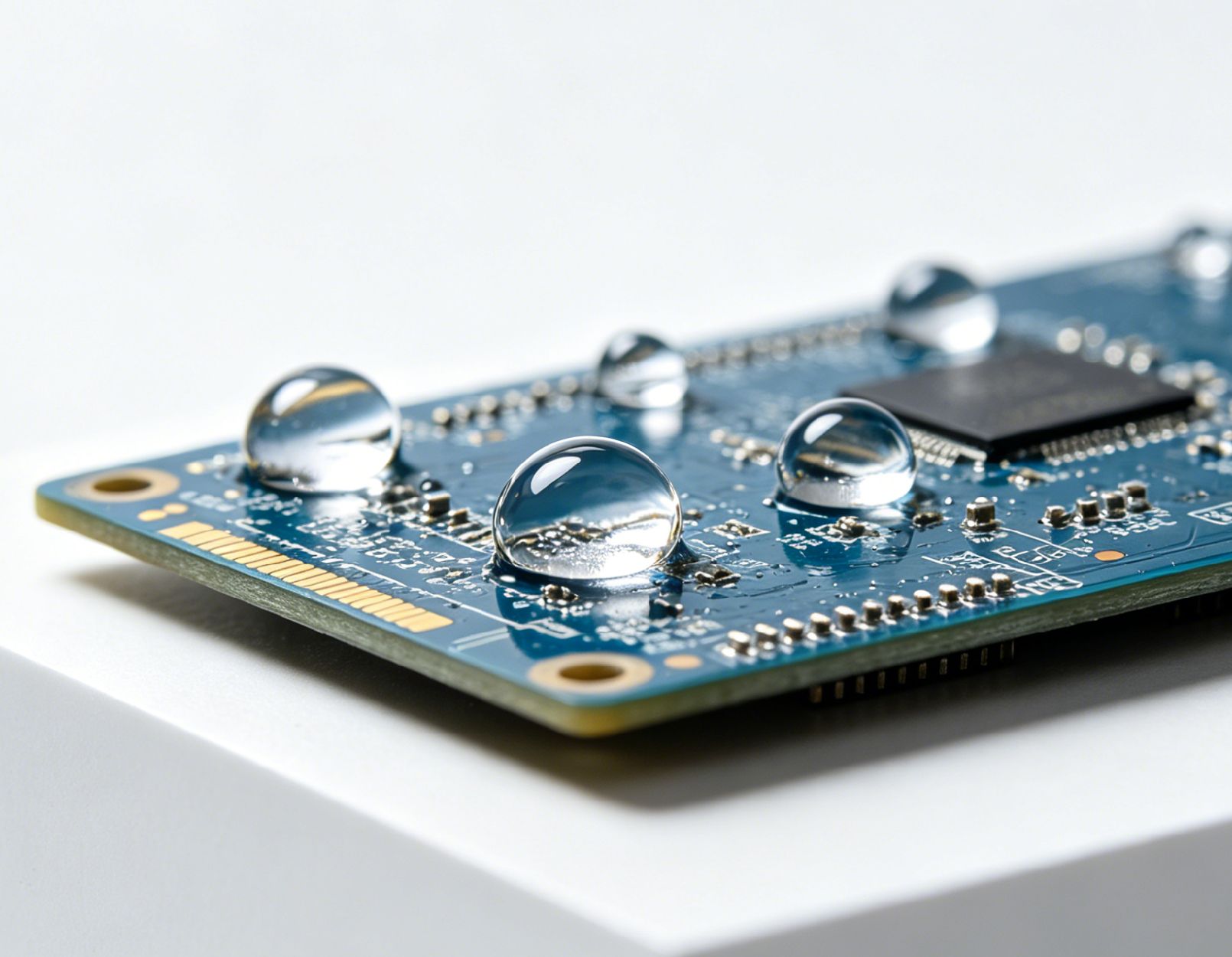
In recent years, the term "superhydrophobic" has appeared with increasing frequency in the realm of electronics protection—so often that it demands serious attention. It conjures up an enticing image: water droplets landing on a circuit board bead up just as they do on a lotus leaf, rolling off effortlessly without lingering for even a moment. If this scenario could be reliably replicated in mass-produced products, it would fundamentally transform the nature of moisture protection for PCBAs.
First, a question: Is superhydrophobicity truly mature?
In recent years, the term "superhydrophobic" has appeared with increasing frequency in the electronics protection sector—so often that it demands serious attention. It conjures up an enticing image: water droplets landing on a circuit board just as they would on a lotus leaf—beading up into tight spheres and rolling away effortlessly, refusing to linger. If this scenario could be reliably replicated in mass-produced products, it would fundamentally transform the nature of moisture protection for PCBA (Printed Circuit Board Assemblies).
However, the more alluring the prospect, the more important it is to step back and ask: Is this technology actually mature? Is it merely a striking photograph from a laboratory, or is it a viable technical solution ready for the production line, inclusion in product specifications, and the rigors of the marketplace? This article aims to provide an objective, in-depth analysis of the maturity of superhydrophobic nano-coatings for electronics protection.
Don't let the prefix "super" mislead you; it has a precise definition.
Before discussing maturity, we must pin down the definition. "Superhydrophobic" is not just a marketing buzzword; it is defined by specific physical standards. Typically, it refers to a solid surface where the water contact angle exceeds 150 degrees, causing water droplets to form near-perfect spheres with a minimal roll-off angle. In contrast, "hydrophobic" and "highly hydrophobic" surfaces exhibit contact angles ranging from 110 to 150 degrees.
What is the significance of this difference? Raising the contact angle from 110 to 150 degrees represents more than just "increased hydrophobicity"; it signifies a fundamental shift in how water behaves on the surface. At 110 degrees, a droplet still "sits" on the surface, albeit in a rounded shape. At angles above 150 degrees, the droplet forms a near-perfect sphere with a minimal contact area; the slightest tilt or vibration causes it to roll off, carrying away surface dust in the process—a phenomenon known as the "self-cleaning effect."
For electronic products, the value of this qualitative shift is immense. This means the surface is not merely "resistant to wetting" but actively "repels water"; condensation struggles to adhere, salt spray droplets cannot linger to form a film, and sweat or rainwater simply roll off upon contact. This represents a protective philosophy entirely different from that of traditional conformal coatings, which rely on sheer thickness to act as a physical barrier.
The First Major Hurdle: From Lab to Production Line
The concept of superhydrophobicity has existed in academia for decades, and creating superhydrophobic surfaces in a laboratory setting has never been difficult. The real challenges lie in three areas: first, achieving a stable superhydrophobic effect; second, replicating this effect on actual circuit boards, complex component geometries, and within mass-production processes; and third, ensuring long-term durability.
Let’s start with stability. Early superhydrophobic surfaces often relied on creating micro- and nano-structures—using rough microscopic topography to "trap" air beneath a droplet, creating an air cushion that yields a high contact angle. While this approach works beautifully on flat glass slides, circuit boards are complex; they feature solder joints, component leads, stepped surfaces, and irregular shapes, resulting in highly uneven microscopic topography. Consequently, solutions relying on geometric roughness fail when applied to actual boards.
This is why viable superhydrophobic coatings for electronics protection utilize a chemical approach rather than a physical one: they employ low-surface-energy materials to form a dense, chemically bonded film that lowers surface energy at the molecular level, rather than relying on surface roughness. Paiqi Nano’s fluorine-modified polyester system follows this path; the resulting film achieves high hydrophobicity—or even superhydrophobicity—through the material's inherent low surface energy rather than micro- or nano-structures, thereby ensuring stability and reproducibility.
Next, consider reproducibility. There is a vast gap between watching a single water droplet roll off a sample in a lab and ensuring that the same effect occurs consistently across every single unit in a production run of a hundred thousand boards; bridging that gap requires a comprehensive system of process control. This is where the advantages of the immersion coating process become apparent: the entire component is submerged in the coating solution, ensuring uniform coverage across every surface. Parameters such as withdrawal speed, solution concentration, and curing temperature are precisely controlled, resulting in consistent film thickness and performance. This offers a level of batch-to-batch consistency that is an order of magnitude superior to spraying or manual brushing.
A Key Benchmark of Maturity: Withstanding the Test of Time and Environment
The maturity of a protective coating cannot be judged solely by its state immediately after application; its true worth lies in whether it holds up after months or years of exposure to real-world conditions.
Durability is the most common point of skepticism regarding superhydrophobic coatings—specifically, whether the hydrophobic effect diminishes over time. This concern stems from historical precedents; early products relying on micro-nano structures to achieve superhydrophobicity often suffered from issues like rubbing off easily or degrading under sunlight. However, for low-surface-energy coatings based on chemical principles, this concern requires a more nuanced analysis.
Durability hinges on two core factors: the strength of the bond between the film and the substrate, and the chemical stability of the coating itself. Paiqi Nano’s coatings utilize a chemical bonding approach, creating a chemical link between the coating and the metal substrate to achieve Grade 0 adhesion—far superior to simply "smearing" on a removable film. By employing a dual-layer strategy—a base layer to enhance bonding and overall protection, and a top layer to boost hydrophobicity—the coating achieves over 1,000 hours of salt spray resistance. These figures are backed by third-party test reports, not merely internal laboratory claims.
Of course, objectively speaking, the contact angle of a superhydrophobic surface will inevitably decline to some extent during long-term use; this is a physical property of materials that no coating can escape. A mature approach does not involve boasting about "zero degradation," but rather controlling the rate of decline within engineering-acceptable limits and offering a product series tailored to different lifespan requirements—ranging from one to three years for consumer electronics to three to twenty years for industrial applications—allowing customers to select the right solution for their needs. That is the hallmark of a mature product. Assessing Maturity: Two Key Indicators
The most reliable indicators of a technology's maturity are not the claims made by vendors, but rather two factors: whether it has achieved genuine, large-scale implementation and whether a comprehensive engineering support ecosystem is in place.
The first factor is the scale of implementation. Since its inception in 2013, Paiqi Nano has spent twelve years working on immersion-based PCBA protection, serving over 300 B2B clients. These clients span sectors such as smartphones, TWS earbuds, wearables, smart home devices, industrial controls, automotive electronics, and security surveillance; notably, most involve mass-produced products rather than mere laboratory prototypes. When a technology is adopted by the consumer electronics industry—a sector characterized by high volumes, thin margins, and low tolerance for error—it demonstrates that it has successfully cleared the hurdles of cost-efficiency, consistency, and reliability required for mass production.
The second factor is engineering support. For a technology to be truly mature, the coating fluid alone is insufficient; a complete set of process parameters, testing methods, equipment solutions, and failure analysis capabilities is required. Immersion-based nano-coatings already feature mature production line solutions—including immersion tanks, withdrawal parameters, and curing ovens—alongside quality control measures such as water contact angle testers, salt spray chambers, and dielectric withstand voltage tests. The completeness of this supporting infrastructure directly determines whether the technology can be reliably used in standard factories, rather than being restricted to specialized workshops.
From this perspective, superhydrophobic nano-coatings for electronics have transitioned from the "laboratory demonstration" phase to the "engineered mass production" stage. Of course, there are limitations: extreme scenarios—such as exposure to highly corrosive agents, ultra-high temperatures, or long-term deep-sea immersion—are not its strong suit; Parylene performs more reliably in those environments. However, for the vast majority of real-world operating conditions faced by electronic products, the technology's maturity is sufficient to underpin large-scale commercial decisions.
A Simple Test for Non-Experts: Are They Willing to Let You Test It?
If you lack a background in materials science but want to quickly determine whether a superhydrophobic coating supplier is reliable, there is a simple yet effective method: observe whether they are willing to let you conduct your own tests and whether they are prepared to fully disclose their data. A mature supplier won't simply show you a photo of a water droplet on a sample or toss out a vague claim like "our contact angle is 150 degrees." Instead, they will specify the testing standards and substrates used, clarify whether the measurement covers static or dynamic contact angles, and provide data on performance degradation over time (aging curves). They will collaborate with you on reliability testing—such as salt spray, "Double 85" (damp heat), and dielectric withstand voltage tests—and may even provide samples for you to trial on your own production line.
Conversely, if a supplier is evasive about test data, speaks only in abstract concepts rather than concrete standards, and provides samples without accompanying reports, you should be wary. In the field of superhydrophobicity, concepts are a dime a dozen; what is truly scarce is data that holds up both in third-party testing reports and on your actual production line. The willingness and ability to conduct rigorous, verifiable testing is, in itself, the most direct proof of maturity.
The real concern isn't whether the technology is mature, but whether you’ve made the right choice.
We can draw a conclusion here: superhydrophobic nano-coatings for electronic protection have reached maturity—not a "universal solution" kind of maturity, but one that is reliable within clearly defined parameters. It is worth laying out exactly which industries are a good fit and what the pros and cons are.
The ideal industries are those that are "water-sensitive, high-volume, and cost-conscious." Examples include consumer electronics (smartphones, earbuds, smartwatches, smart speakers), industrial electronics (electricity meters, controllers, sensors), automotive electronics (BMS units, lighting systems, domain controllers), and security equipment (outdoor cameras). These products share common characteristics: they operate in potentially humid or harsh environments, yet require high-volume production, are sensitive to costs and cycle times, and necessitate repairability. These are precisely the areas where superhydrophobic nano-coatings excel.
The advantages have already been detailed: the coating is ultra-thin, requires no masking, cures rapidly, allows for rework, has negligible impact on heat dissipation and signal transmission, and offers superior moisture and water resistance. It is also important to be honest about the drawbacks: its ultimate barrier performance falls short of Parylene, and it is unsuitable for environments involving extreme heat or highly corrosive substances. Additionally, the contact angle will experience normal degradation within an acceptable engineering range, and the process demands precise control—failure to properly manage parameters like immersion and withdrawal speeds can compromise consistency.
Therefore, the real task isn't to get hung up on the question of whether "superhydrophobicity" is a mature technology—that has essentially been answered—but rather to clearly determine whether your product needs it, which specific series to use, and how to implement the process. Once you have thought these three issues through, you can leave the rest to prototyping and testing for verification.
When a technology moves from the laboratory to the production line, the hardest part isn't achieving a 150-degree contact angle; it is ensuring that this 150-degree performance is consistently maintained on every single board that rolls off the line. After twelve years of development, superhydrophobic nano-coatings for electronics are no longer a questionable new concept, but a mature option worthy of serious consideration for your product specifications. The only remaining question is whether you have the courage—and the need—to let this technology shield your product from unseen moisture.
In recent years, the term "superhydrophobic" has appeared with increasing frequency in the realm of electronics protection—so often that it demands serious attention. It conjures up an enticing image: water droplets landing on a circuit board bead up just as they do on a lotus leaf, rolling off effortlessly without lingering for even a moment. If this scenario could be reliably replicated in mass-produced products, it would fundamentally transform the nature of moisture protection for PCBAs.
First, a question: Is superhydrophobicity truly mature?
In recent years, the term "superhydrophobic" has appeared with increasing frequency in the electronics protection sector—so often that it demands serious attention. It conjures up an enticing image: water droplets landing on a circuit board just as they would on a lotus leaf—beading up into tight spheres and rolling away effortlessly, refusing to linger. If this scenario could be reliably replicated in mass-produced products, it would fundamentally transform the nature of moisture protection for PCBA (Printed Circuit Board Assemblies).
However, the more alluring the prospect, the more important it is to step back and ask: Is this technology actually mature? Is it merely a striking photograph from a laboratory, or is it a viable technical solution ready for the production line, inclusion in product specifications, and the rigors of the marketplace? This article aims to provide an objective, in-depth analysis of the maturity of superhydrophobic nano-coatings for electronics protection.
Don't let the prefix "super" mislead you; it has a precise definition.
Before discussing maturity, we must pin down the definition. "Superhydrophobic" is not just a marketing buzzword; it is defined by specific physical standards. Typically, it refers to a solid surface where the water contact angle exceeds 150 degrees, causing water droplets to form near-perfect spheres with a minimal roll-off angle. In contrast, "hydrophobic" and "highly hydrophobic" surfaces exhibit contact angles ranging from 110 to 150 degrees.
What is the significance of this difference? Raising the contact angle from 110 to 150 degrees represents more than just "increased hydrophobicity"; it signifies a fundamental shift in how water behaves on the surface. At 110 degrees, a droplet still "sits" on the surface, albeit in a rounded shape. At angles above 150 degrees, the droplet forms a near-perfect sphere with a minimal contact area; the slightest tilt or vibration causes it to roll off, carrying away surface dust in the process—a phenomenon known as the "self-cleaning effect."
For electronic products, the value of this qualitative shift is immense. This means the surface is not merely "resistant to wetting" but actively "repels water"; condensation struggles to adhere, salt spray droplets cannot linger to form a film, and sweat or rainwater simply roll off upon contact. This represents a protective philosophy entirely different from that of traditional conformal coatings, which rely on sheer thickness to act as a physical barrier.
The First Major Hurdle: From Lab to Production Line
The concept of superhydrophobicity has existed in academia for decades, and creating superhydrophobic surfaces in a laboratory setting has never been difficult. The real challenges lie in three areas: first, achieving a stable superhydrophobic effect; second, replicating this effect on actual circuit boards, complex component geometries, and within mass-production processes; and third, ensuring long-term durability.
Let’s start with stability. Early superhydrophobic surfaces often relied on creating micro- and nano-structures—using rough microscopic topography to "trap" air beneath a droplet, creating an air cushion that yields a high contact angle. While this approach works beautifully on flat glass slides, circuit boards are complex; they feature solder joints, component leads, stepped surfaces, and irregular shapes, resulting in highly uneven microscopic topography. Consequently, solutions relying on geometric roughness fail when applied to actual boards.
This is why viable superhydrophobic coatings for electronics protection utilize a chemical approach rather than a physical one: they employ low-surface-energy materials to form a dense, chemically bonded film that lowers surface energy at the molecular level, rather than relying on surface roughness. Paiqi Nano’s fluorine-modified polyester system follows this path; the resulting film achieves high hydrophobicity—or even superhydrophobicity—through the material's inherent low surface energy rather than micro- or nano-structures, thereby ensuring stability and reproducibility.
Next, consider reproducibility. There is a vast gap between watching a single water droplet roll off a sample in a lab and ensuring that the same effect occurs consistently across every single unit in a production run of a hundred thousand boards; bridging that gap requires a comprehensive system of process control. This is where the advantages of the immersion coating process become apparent: the entire component is submerged in the coating solution, ensuring uniform coverage across every surface. Parameters such as withdrawal speed, solution concentration, and curing temperature are precisely controlled, resulting in consistent film thickness and performance. This offers a level of batch-to-batch consistency that is an order of magnitude superior to spraying or manual brushing.
A Key Benchmark of Maturity: Withstanding the Test of Time and Environment
The maturity of a protective coating cannot be judged solely by its state immediately after application; its true worth lies in whether it holds up after months or years of exposure to real-world conditions.
Durability is the most common point of skepticism regarding superhydrophobic coatings—specifically, whether the hydrophobic effect diminishes over time. This concern stems from historical precedents; early products relying on micro-nano structures to achieve superhydrophobicity often suffered from issues like rubbing off easily or degrading under sunlight. However, for low-surface-energy coatings based on chemical principles, this concern requires a more nuanced analysis.
Durability hinges on two core factors: the strength of the bond between the film and the substrate, and the chemical stability of the coating itself. Paiqi Nano’s coatings utilize a chemical bonding approach, creating a chemical link between the coating and the metal substrate to achieve Grade 0 adhesion—far superior to simply "smearing" on a removable film. By employing a dual-layer strategy—a base layer to enhance bonding and overall protection, and a top layer to boost hydrophobicity—the coating achieves over 1,000 hours of salt spray resistance. These figures are backed by third-party test reports, not merely internal laboratory claims.
Of course, objectively speaking, the contact angle of a superhydrophobic surface will inevitably decline to some extent during long-term use; this is a physical property of materials that no coating can escape. A mature approach does not involve boasting about "zero degradation," but rather controlling the rate of decline within engineering-acceptable limits and offering a product series tailored to different lifespan requirements—ranging from one to three years for consumer electronics to three to twenty years for industrial applications—allowing customers to select the right solution for their needs. That is the hallmark of a mature product. Assessing Maturity: Two Key Indicators
The most reliable indicators of a technology's maturity are not the claims made by vendors, but rather two factors: whether it has achieved genuine, large-scale implementation and whether a comprehensive engineering support ecosystem is in place.
The first factor is the scale of implementation. Since its inception in 2013, Paiqi Nano has spent twelve years working on immersion-based PCBA protection, serving over 300 B2B clients. These clients span sectors such as smartphones, TWS earbuds, wearables, smart home devices, industrial controls, automotive electronics, and security surveillance; notably, most involve mass-produced products rather than mere laboratory prototypes. When a technology is adopted by the consumer electronics industry—a sector characterized by high volumes, thin margins, and low tolerance for error—it demonstrates that it has successfully cleared the hurdles of cost-efficiency, consistency, and reliability required for mass production.
The second factor is engineering support. For a technology to be truly mature, the coating fluid alone is insufficient; a complete set of process parameters, testing methods, equipment solutions, and failure analysis capabilities is required. Immersion-based nano-coatings already feature mature production line solutions—including immersion tanks, withdrawal parameters, and curing ovens—alongside quality control measures such as water contact angle testers, salt spray chambers, and dielectric withstand voltage tests. The completeness of this supporting infrastructure directly determines whether the technology can be reliably used in standard factories, rather than being restricted to specialized workshops.
From this perspective, superhydrophobic nano-coatings for electronics have transitioned from the "laboratory demonstration" phase to the "engineered mass production" stage. Of course, there are limitations: extreme scenarios—such as exposure to highly corrosive agents, ultra-high temperatures, or long-term deep-sea immersion—are not its strong suit; Parylene performs more reliably in those environments. However, for the vast majority of real-world operating conditions faced by electronic products, the technology's maturity is sufficient to underpin large-scale commercial decisions.
A Simple Test for Non-Experts: Are They Willing to Let You Test It?
If you lack a background in materials science but want to quickly determine whether a superhydrophobic coating supplier is reliable, there is a simple yet effective method: observe whether they are willing to let you conduct your own tests and whether they are prepared to fully disclose their data. A mature supplier won't simply show you a photo of a water droplet on a sample or toss out a vague claim like "our contact angle is 150 degrees." Instead, they will specify the testing standards and substrates used, clarify whether the measurement covers static or dynamic contact angles, and provide data on performance degradation over time (aging curves). They will collaborate with you on reliability testing—such as salt spray, "Double 85" (damp heat), and dielectric withstand voltage tests—and may even provide samples for you to trial on your own production line.
Conversely, if a supplier is evasive about test data, speaks only in abstract concepts rather than concrete standards, and provides samples without accompanying reports, you should be wary. In the field of superhydrophobicity, concepts are a dime a dozen; what is truly scarce is data that holds up both in third-party testing reports and on your actual production line. The willingness and ability to conduct rigorous, verifiable testing is, in itself, the most direct proof of maturity.
The real concern isn't whether the technology is mature, but whether you’ve made the right choice.
We can draw a conclusion here: superhydrophobic nano-coatings for electronic protection have reached maturity—not a "universal solution" kind of maturity, but one that is reliable within clearly defined parameters. It is worth laying out exactly which industries are a good fit and what the pros and cons are.
The ideal industries are those that are "water-sensitive, high-volume, and cost-conscious." Examples include consumer electronics (smartphones, earbuds, smartwatches, smart speakers), industrial electronics (electricity meters, controllers, sensors), automotive electronics (BMS units, lighting systems, domain controllers), and security equipment (outdoor cameras). These products share common characteristics: they operate in potentially humid or harsh environments, yet require high-volume production, are sensitive to costs and cycle times, and necessitate repairability. These are precisely the areas where superhydrophobic nano-coatings excel.
The advantages have already been detailed: the coating is ultra-thin, requires no masking, cures rapidly, allows for rework, has negligible impact on heat dissipation and signal transmission, and offers superior moisture and water resistance. It is also important to be honest about the drawbacks: its ultimate barrier performance falls short of Parylene, and it is unsuitable for environments involving extreme heat or highly corrosive substances. Additionally, the contact angle will experience normal degradation within an acceptable engineering range, and the process demands precise control—failure to properly manage parameters like immersion and withdrawal speeds can compromise consistency.
Therefore, the real task isn't to get hung up on the question of whether "superhydrophobicity" is a mature technology—that has essentially been answered—but rather to clearly determine whether your product needs it, which specific series to use, and how to implement the process. Once you have thought these three issues through, you can leave the rest to prototyping and testing for verification.
When a technology moves from the laboratory to the production line, the hardest part isn't achieving a 150-degree contact angle; it is ensuring that this 150-degree performance is consistently maintained on every single board that rolls off the line. After twelve years of development, superhydrophobic nano-coatings for electronics are no longer a questionable new concept, but a mature option worthy of serious consideration for your product specifications. The only remaining question is whether you have the courage—and the need—to let this technology shield your product from unseen moisture.