
Electronic protection solutions for IoT terminals,Sino-Fluorine Nanoelectronic Protection Solution
Electronic protection solutions for IoT devices - Sino-Fluorine nanoelectronic protection solution
In 2026, global shipments of smart home devices exceeded 1.07 billion units (IDC data). From smart door locks and smart curtains to electric clothes racks on balconies and outdoor security cameras, IoT terminals are penetrating every corner of daily life at an unprecedented pace. However, humidity, condensation, and water ingress—these three problems known as the "invisible killers of smart homes"—continue to plague device manufacturers and end users. Waterproofing and moisture resistance for smart home devices are no longer an option, but a rigid bottom line for product reliability. This article will focus on the theme of IoT terminal protection, systematically analyzing the real-world humidity scenarios faced by smart home devices, and how nano-coating immersion technology can technically solve these pain points.
I. The Humidity Dilemma of Smart Homes: Eight Typical Scenarios
The installation location of smart home devices dictates that they must face various complex humidity environments—indoor water vapor, outdoor rainwater, and seasonal condensation, each of which can potentially trigger circuit board failure. Based on repair cases related to humidity-related malfunctions during the humid season in southern China, the following eight scenarios represent the areas with the highest rates of such malfunctions: Statistics show that in 2005, the average household experienced three television malfunctions due to moisture during the plum rain season. By 2025, the repair cost of damaged smart home devices could reach 40% of the device's value, making humidity-related malfunctions a core contributing factor to electronic device repairs.
1. Bathroom Smart Mirror and Bathroom Heater Control Board
The bathroom is the area with the highest humidity in the home, with water vapor concentrations reaching over 95% RH during showers. The touch panel of the smart mirror and the control board of the bathroom heater are constantly exposed to the steam environment. Even with a sealed casing, condensation caused by internal temperature differences can still cause short circuits on the circuit boards.
2. Balcony Smart Curtain Motor and Clothes Rack
The balcony is an area where indoor and outdoor temperatures converge. In winter, indoor heating and cold outdoor air create condensation around the windows. According to current product specifications for smart curtain motors, their permissible operating environment is humidity ≤95%RH (non-condensing). If the circuit board built into the smart curtain motor is exposed to this excessive condensation environment for a prolonged period, just as high humidity condensation environments significantly increase the failure rate of electrical equipment, the motor's Hall sensor and main control chip are highly susceptible to moisture failure.
3. Smart Door Lock (Outdoor Side)
Moisture protection of the smart door lock's mainboard is one of the most challenging issues in the field of IoT terminal protection. Smart door locks installed on entrance doors are exposed to both outdoor wind and rain and indoor heating; the alternating hot and cold temperatures cause significant condensation inside the lock. Data shows that during the humid season in southern China, the failure rate of smart door locks can reach 15%-20%, with over 70% of these failures directly related to humidity.
4. Smart Garden Lighting and Irrigation Controllers
Smart lighting modules and automatic irrigation controllers in outdoor courtyards are constantly exposed to wind and rain, experiencing large temperature differences between day and night, and rising soil moisture. The PCBA circuit boards for these types of devices must simultaneously meet the protection challenges of three different dimensions: waterproofing, condensation prevention, and salt spray resistance.
5. Garage Door Smart Controller and Fresh Air System Control Board
Underground garages typically have high humidity levels. Vehicles entering and exiting bring in rainwater, and poor ventilation easily leads to moisture buildup inside the controller. The fresh air system's main control board is located near the outdoor air intake, and the direct contact of hot, humid air with the circuit board also poses a risk of condensation.
6. Underfloor Heating Thermostat and Smart Panel
Underfloor heating thermostats are installed on interior walls, and the temperature difference between the surface and the wall makes condensation prone to form inside the panel in winter. Smart wall panels (supporting lighting control and scene switching functions) face similar problems, and the high installation density of these devices results in higher overall repair costs in case of malfunction.
II. Why are traditional protection solutions insufficient?
Faced with the eight humid scenarios mentioned above, the industry has traditionally relied on three main solutions: waterproofing with sealing rings, potting compound, and conformal coating. However, these three solutions each have their own structural flaws in protecting smart home IoT terminals.
Sealing Ring Waterproofing: Outer Casing Waterproofing ≠ Internal Security
Waterproofing with sealing rings and adhesive only prevents direct intrusion of external liquid water; it cannot solve the problem of internal condensation. When smart door locks experience temperature changes, moisture in the air inside the casing condenses on the circuit board surface. The tighter the seal, the more difficult it is for moisture to escape. Smart home PCBA protection cannot rely solely on outer casing sealing; it must start with the circuit board itself.
Conformal Coating: The Conflict Between Thickness and Heat Dissipation
According to relevant standards in the PCBA manufacturing industry, the standard thickness of traditional conformal coatings ranges from 25-127 μm. In industry applications, the coating thickness for traditional products is typically controlled between 25-100 μm. Production also explicitly requires the use of the thinnest coating material to provide protection for circuit boards, minimizing heat retention. This thickness range significantly impacts the heat dissipation of power devices—temperature rise can increase by 5-8°C. Masking is necessary when coating connector areas, and this masking process accounts for more than 50% of the total coating time. Conformal coatings contain organic solvents, with VOCs reaching 200-400 g/L, which is neither environmentally friendly nor healthy for operators.
Potting Compound: Reliable but Unrepairable
While potting compounds offer high protection, they are heavy and have poor thermal conductivity. If internal components fail, the entire PCBA must be scrapped. For products like smart door locks and smart curtain motors, which already have high after-sales maintenance costs, potting solutions have a fatal flaw in terms of maintainability.
| Comparison Dimensions | Sealing ring + structural waterproofing | Traditional three-proof paint | potting compound | The Sino-Fluorine 1700 series |
|---|---|---|---|---|
| Waterproofing | Shell level, internal condensation ineffective | Good (but pinhole defects are common) | excellent | IPX7 rating, providing both internal and external protection. |
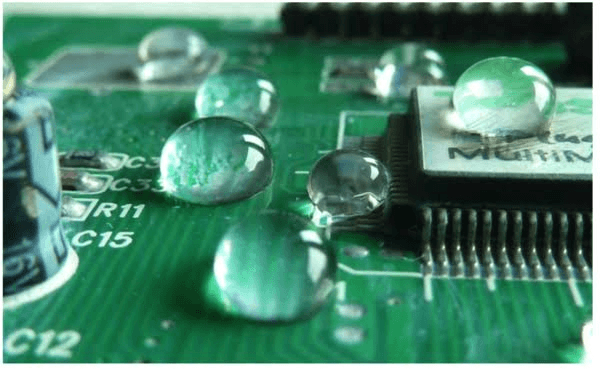
| Moisture-proof/Anti-condensation | Unable to resolve internal condensation | Generally, thick films affect heat dissipation. | good | Water contact angle >115°, condensation slides off naturally. |
| Unit Comprehensive Cost | Medium (mold + seals) | Medium to high (masking + baking + rework) | high | Low (no masking required, cures in 3 minutes) |
| process complexity | Medium (with many assembly processes) | High (masking → spraying → baking → masking removal) | High (adhesive preparation + potting + curing) | Low (immersion for 3 seconds, curing at room temperature for 3 minutes) |
| Maintainability | It can be disassembled but it takes a long time. | Solderable with a soldering iron, but requires local paint removal. | Unrepairable, the entire board is scrapped. | Solderable directly with a soldering iron, no glue removal required. |
| Environmental protection | none | VOC 200-400g/L | VOCs are moderate. | Zero VOCs, non-toxic and harmless |
III. Sino-Fluorine Nanocoating Immersion Solution Technology Analysis
The Sino-Fluorine 1700 series nanocoating is a new generation of immersion-type nano-protection solution developed by Sino-Fluorine for the protection of smart home IoT terminals. Unlike traditional conformal coatings or potting compounds, the 1700 series redefines the PCBA protection process standard with four key technical features: "3-second immersion, 3-minute curing, no masking required, and zero impact on conductivity."
3-Second Immersion, 360° Coverage Without Dead Angles
The Sino-Fluorine 1700 series nanocoating uses a fluorine-modified polyester nanomaterial formula, featuring ultra-low viscosity and ultra-high leveling properties. Immersing the PCBA in the Sino-Fluorine 1700 series nanocoating solution for 3 seconds allows the solution to penetrate evenly through capillary action into areas that traditional spraying processes cannot cover, such as the bottom of components, solder joint gaps, and the base of IC pins. No matter how complex the board structure, the Sino-Fluorine 1700 series nano-coating achieves 360° all-around coverage, ensuring that every solder joint and component is protected by a nano-film.
4-minute room temperature curing, seamless integration with production line cycles
The Sino-Fluorine 1700 series nano-coating cures rapidly at room temperature in approximately 3 minutes, requiring no baking equipment. It can be seamlessly integrated into existing production line cycles, allowing a single production line to process thousands of PCBAs per hour, completely eliminating capacity bottlenecks.
Ultra-thin 0.8-3μm thickness, unaffected by heat dissipation or conductivity
The Sino-Fluorine 1700 series nano-coating, after curing, has a coating thickness of only 0.8-3μm, far lower than the industry standard of 20μm-350μm for traditional conformal coatings. This has virtually no impact on the heat dissipation of power devices (temperature rise difference <0.5℃), solving the industry problem of thick-film heat insulation in traditional conformal coatings. It also increases connector contact resistance by <1mΩ, fully complying with IPC-4552 standards. Waterproofing of smart door lock motherboards no longer requires shielding FPC cables and slots before immersion.
Zero-VOC environmentally friendly formula, meeting global environmental regulations
The Sino-Fluorine 1700 series nano-coating uses a fully water-based system, eliminating organic solvents at the source, resulting in zero VOC content. With the EU RoHS directive and REACH regulations becoming increasingly stringent, and domestic VOC emission standards becoming more stringent, zero-VOC nano-coating solutions are transitioning from a "bonus" to a "must-have." Meanwhile, zero VOCs mean that the production line does not need to install expensive waste gas treatment equipment, significantly reducing the company's environmental compliance costs.
IV. Real-world Deployment Case Study: Data Comparison from a Smart Lock Manufacturer
Taking a leading domestic smart lock brand as an example, this manufacturer produces over 2 million smart locks annually, covering both entry door locks and patio locks. Previously, using traditional conformal coating spraying, each batch of 200 PCBAs required 3 workers spending 4 hours to complete the entire process of masking, spraying, baking, and removing the mask, resulting in a consistently high after-sales return rate of around 6.8%.
Data Comparison After Switching to the Sino-Fluorine 1700 Series Nano-Coating Immersion Process
In Q3 2025, the manufacturer switched production to the Sino-Fluorine 1700 series nano-coating immersion solution. After the switch, one worker could complete the immersion of 200 PCBAs in 15 minutes, increasing efficiency by 16 times. The production line pass rate increased from 96.2% to 99.6%, and the PPM failure rate decreased from 380 to 42. After six months of continuous tracking, the after-sales return rate dropped from 6.8% to 2.1%, a decrease of 69%. Among these, the proportion of motherboard failures caused by moisture decreased from 71% to 12%. Based on an estimated annual shipment of 2 million units, this translates to savings of over 2 million yuan in after-sales costs alone.
It is worth noting that the manufacturer also gained additional process advantages after switching to the Sino-Fluorine 1700 series nano-coating solution: industry process data shows that this type of nano-coating has the characteristic of being able to be processed directly without shielding the connectors, which is significantly different from traditional coating solutions that require connector shielding. Therefore, the two workers originally responsible for the shielding process on the manufacturer's production line could be reassigned to assembly and testing stations, further freeing up manpower.
V. Selection Recommendations: How to Choose the Right Nanocoating for Smart Home Devices?
Smart home products are diverse, with vastly different installation environments and protection requirements. The Sino-Fluorine 1700 series nanocoatings cover a complete product range from basic moisture protection to extreme protection. Engineers should select the most suitable model based on the actual operating environment of the device.
1701/1702: Basic Moisture Protection for Low-Risk Indoor Scenarios
For devices in dry indoor environments, such as smart remote controls, smart switch panels, and temperature and humidity sensors, 1701 (1% solids content, 0.1-0.7μm film thickness) or 1702 (2% solids content, 0.1-1.5μm film thickness) will meet basic moisture protection requirements. In these scenarios, the moisture concentration is low, and the focus of protection is preventing long-term oxidation of the solder joints by water molecules in the air.
1704: A Cost-Effective Choice for Moderately Humid Environments
Smart curtain motors, indoor gateways, and voice speakers are often installed near windows or vents, facing the risk of periodic condensation. 1704 (4% solids content, film thickness 0.5-2.6μm) offers added mild water resistance on top of its moisture-proof properties, with a moderate cost, making it the primary model for medium-risk scenarios.
1705: The "Golden Choice" for Smart Home IoT Terminal Protection
For core devices facing direct water splashes or high salt spray corrosion risks, such as smart door locks, pet feeders, and smart toilet control panels, 1705 (5% solids content, film thickness 0.8-3.0μm) is recommended. 1705 covers over 90% of smart home protection scenarios, achieving an optimal balance in moisture resistance, condensation prevention, and salt spray resistance, making it the core waterproofing solution for smart door lock motherboards recommended in this article.
1708/1710: Full Protection for Extreme Outdoor Environments
Outdoor security cameras, yard light controllers, charging pile control boards, and other devices constantly exposed to wind and rain require protection at the 1708 (8% solids content, 1.4-3.6μm film thickness) or 1710 (10% solids content, 2.0-4.5μm film thickness) level. 1710 achieves full protection, passing over 1000 hours of neutral salt spray testing. It can cover the PCB and component pins of outdoor IoT terminals, preventing signal drift caused by oxidation, and is suitable for the most demanding outdoor IoT terminal protection scenarios.
VI. Conclusion
The reliability of smart home devices depends not only on the casing and chip performance but also on the circuit board's ability to survive in humid environments. Solutions for waterproofing and moisture protection of smart home devices are shifting from traditional "blocking" to a combination of "drainage" and "prevention"—nano-coatings act like an invisible protective layer for the PCBA, preventing moisture from contacting the circuit without affecting the circuit board's heat dissipation, conductivity, or maintainability.
Sino-Fluorine 1700 series immersion nano-coatings offer advantages such as 3-second immersion, 3-minute curing, no need for masking, and zero VOCs, providing a high-performance and cost-effective technological path for the protection of smart home IoT terminals. The current smart home industry has exceeded one trillion yuan in scale, and it is projected that by 2026, the penetration rate of smart homes in China will exceed 35%, with a market size reaching 800 billion yuan. Against the backdrop of continuously rising penetration rates, leading smart home companies, including Midea and Huawei, have incorporated sensor moisture-proof coatings and smart home PCBA protection into the early stages of product reliability design, making it a common choice for these leading companies.
Electronic protection solutions for IoT terminals,Sino-Fluorine Nanoelectronic Protection Solution
Electronic protection solutions for IoT devices - Sino-Fluorine nanoelectronic protection solution
In 2026, global shipments of smart home devices exceeded 1.07 billion units (IDC data). From smart door locks and smart curtains to electric clothes racks on balconies and outdoor security cameras, IoT terminals are penetrating every corner of daily life at an unprecedented pace. However, humidity, condensation, and water ingress—these three problems known as the "invisible killers of smart homes"—continue to plague device manufacturers and end users. Waterproofing and moisture resistance for smart home devices are no longer an option, but a rigid bottom line for product reliability. This article will focus on the theme of IoT terminal protection, systematically analyzing the real-world humidity scenarios faced by smart home devices, and how nano-coating immersion technology can technically solve these pain points.
I. The Humidity Dilemma of Smart Homes: Eight Typical Scenarios
The installation location of smart home devices dictates that they must face various complex humidity environments—indoor water vapor, outdoor rainwater, and seasonal condensation, each of which can potentially trigger circuit board failure. Based on repair cases related to humidity-related malfunctions during the humid season in southern China, the following eight scenarios represent the areas with the highest rates of such malfunctions: Statistics show that in 2005, the average household experienced three television malfunctions due to moisture during the plum rain season. By 2025, the repair cost of damaged smart home devices could reach 40% of the device's value, making humidity-related malfunctions a core contributing factor to electronic device repairs.
1. Bathroom Smart Mirror and Bathroom Heater Control Board
The bathroom is the area with the highest humidity in the home, with water vapor concentrations reaching over 95% RH during showers. The touch panel of the smart mirror and the control board of the bathroom heater are constantly exposed to the steam environment. Even with a sealed casing, condensation caused by internal temperature differences can still cause short circuits on the circuit boards.
2. Balcony Smart Curtain Motor and Clothes Rack
The balcony is an area where indoor and outdoor temperatures converge. In winter, indoor heating and cold outdoor air create condensation around the windows. According to current product specifications for smart curtain motors, their permissible operating environment is humidity ≤95%RH (non-condensing). If the circuit board built into the smart curtain motor is exposed to this excessive condensation environment for a prolonged period, just as high humidity condensation environments significantly increase the failure rate of electrical equipment, the motor's Hall sensor and main control chip are highly susceptible to moisture failure.
3. Smart Door Lock (Outdoor Side)
Moisture protection of the smart door lock's mainboard is one of the most challenging issues in the field of IoT terminal protection. Smart door locks installed on entrance doors are exposed to both outdoor wind and rain and indoor heating; the alternating hot and cold temperatures cause significant condensation inside the lock. Data shows that during the humid season in southern China, the failure rate of smart door locks can reach 15%-20%, with over 70% of these failures directly related to humidity.
4. Smart Garden Lighting and Irrigation Controllers
Smart lighting modules and automatic irrigation controllers in outdoor courtyards are constantly exposed to wind and rain, experiencing large temperature differences between day and night, and rising soil moisture. The PCBA circuit boards for these types of devices must simultaneously meet the protection challenges of three different dimensions: waterproofing, condensation prevention, and salt spray resistance.
5. Garage Door Smart Controller and Fresh Air System Control Board
Underground garages typically have high humidity levels. Vehicles entering and exiting bring in rainwater, and poor ventilation easily leads to moisture buildup inside the controller. The fresh air system's main control board is located near the outdoor air intake, and the direct contact of hot, humid air with the circuit board also poses a risk of condensation.
6. Underfloor Heating Thermostat and Smart Panel
Underfloor heating thermostats are installed on interior walls, and the temperature difference between the surface and the wall makes condensation prone to form inside the panel in winter. Smart wall panels (supporting lighting control and scene switching functions) face similar problems, and the high installation density of these devices results in higher overall repair costs in case of malfunction.
II. Why are traditional protection solutions insufficient?
Faced with the eight humid scenarios mentioned above, the industry has traditionally relied on three main solutions: waterproofing with sealing rings, potting compound, and conformal coating. However, these three solutions each have their own structural flaws in protecting smart home IoT terminals.
Sealing Ring Waterproofing: Outer Casing Waterproofing ≠ Internal Security
Waterproofing with sealing rings and adhesive only prevents direct intrusion of external liquid water; it cannot solve the problem of internal condensation. When smart door locks experience temperature changes, moisture in the air inside the casing condenses on the circuit board surface. The tighter the seal, the more difficult it is for moisture to escape. Smart home PCBA protection cannot rely solely on outer casing sealing; it must start with the circuit board itself.
Conformal Coating: The Conflict Between Thickness and Heat Dissipation
According to relevant standards in the PCBA manufacturing industry, the standard thickness of traditional conformal coatings ranges from 25-127 μm. In industry applications, the coating thickness for traditional products is typically controlled between 25-100 μm. Production also explicitly requires the use of the thinnest coating material to provide protection for circuit boards, minimizing heat retention. This thickness range significantly impacts the heat dissipation of power devices—temperature rise can increase by 5-8°C. Masking is necessary when coating connector areas, and this masking process accounts for more than 50% of the total coating time. Conformal coatings contain organic solvents, with VOCs reaching 200-400 g/L, which is neither environmentally friendly nor healthy for operators.
Potting Compound: Reliable but Unrepairable
While potting compounds offer high protection, they are heavy and have poor thermal conductivity. If internal components fail, the entire PCBA must be scrapped. For products like smart door locks and smart curtain motors, which already have high after-sales maintenance costs, potting solutions have a fatal flaw in terms of maintainability.
| Comparison Dimensions | Sealing ring + structural waterproofing | Traditional three-proof paint | potting compound | The Sino-Fluorine 1700 series |
|---|---|---|---|---|
| Waterproofing | Shell level, internal condensation ineffective | Good (but pinhole defects are common) | excellent | IPX7 rating, providing both internal and external protection. |
| Moisture-proof/Anti-condensation | Unable to resolve internal condensation | Generally, thick films affect heat dissipation. | good | Water contact angle >115°, condensation slides off naturally. |
| Unit Comprehensive Cost | Medium (mold + seals) | Medium to high (masking + baking + rework) | high | Low (no masking required, cures in 3 minutes) |
| process complexity | Medium (with many assembly processes) | High (masking → spraying → baking → masking removal) | High (adhesive preparation + potting + curing) | Low (immersion for 3 seconds, curing at room temperature for 3 minutes) |
| Maintainability | It can be disassembled but it takes a long time. | Solderable with a soldering iron, but requires local paint removal. | Unrepairable, the entire board is scrapped. | Solderable directly with a soldering iron, no glue removal required. |
| Environmental protection | none | VOC 200-400g/L | VOCs are moderate. | Zero VOCs, non-toxic and harmless |
III. Sino-Fluorine Nanocoating Immersion Solution Technology Analysis
The Sino-Fluorine 1700 series nanocoating is a new generation of immersion-type nano-protection solution developed by Sino-Fluorine for the protection of smart home IoT terminals. Unlike traditional conformal coatings or potting compounds, the 1700 series redefines the PCBA protection process standard with four key technical features: "3-second immersion, 3-minute curing, no masking required, and zero impact on conductivity."
3-Second Immersion, 360° Coverage Without Dead Angles
The Sino-Fluorine 1700 series nanocoating uses a fluorine-modified polyester nanomaterial formula, featuring ultra-low viscosity and ultra-high leveling properties. Immersing the PCBA in the Sino-Fluorine 1700 series nanocoating solution for 3 seconds allows the solution to penetrate evenly through capillary action into areas that traditional spraying processes cannot cover, such as the bottom of components, solder joint gaps, and the base of IC pins. No matter how complex the board structure, the Sino-Fluorine 1700 series nano-coating achieves 360° all-around coverage, ensuring that every solder joint and component is protected by a nano-film.
4-minute room temperature curing, seamless integration with production line cycles
The Sino-Fluorine 1700 series nano-coating cures rapidly at room temperature in approximately 3 minutes, requiring no baking equipment. It can be seamlessly integrated into existing production line cycles, allowing a single production line to process thousands of PCBAs per hour, completely eliminating capacity bottlenecks.
Ultra-thin 0.8-3μm thickness, unaffected by heat dissipation or conductivity
The Sino-Fluorine 1700 series nano-coating, after curing, has a coating thickness of only 0.8-3μm, far lower than the industry standard of 20μm-350μm for traditional conformal coatings. This has virtually no impact on the heat dissipation of power devices (temperature rise difference <0.5℃), solving the industry problem of thick-film heat insulation in traditional conformal coatings. It also increases connector contact resistance by <1mΩ, fully complying with IPC-4552 standards. Waterproofing of smart door lock motherboards no longer requires shielding FPC cables and slots before immersion.
Zero-VOC environmentally friendly formula, meeting global environmental regulations
The Sino-Fluorine 1700 series nano-coating uses a fully water-based system, eliminating organic solvents at the source, resulting in zero VOC content. With the EU RoHS directive and REACH regulations becoming increasingly stringent, and domestic VOC emission standards becoming more stringent, zero-VOC nano-coating solutions are transitioning from a "bonus" to a "must-have." Meanwhile, zero VOCs mean that the production line does not need to install expensive waste gas treatment equipment, significantly reducing the company's environmental compliance costs.
IV. Real-world Deployment Case Study: Data Comparison from a Smart Lock Manufacturer
Taking a leading domestic smart lock brand as an example, this manufacturer produces over 2 million smart locks annually, covering both entry door locks and patio locks. Previously, using traditional conformal coating spraying, each batch of 200 PCBAs required 3 workers spending 4 hours to complete the entire process of masking, spraying, baking, and removing the mask, resulting in a consistently high after-sales return rate of around 6.8%.
Data Comparison After Switching to the Sino-Fluorine 1700 Series Nano-Coating Immersion Process
In Q3 2025, the manufacturer switched production to the Sino-Fluorine 1700 series nano-coating immersion solution. After the switch, one worker could complete the immersion of 200 PCBAs in 15 minutes, increasing efficiency by 16 times. The production line pass rate increased from 96.2% to 99.6%, and the PPM failure rate decreased from 380 to 42. After six months of continuous tracking, the after-sales return rate dropped from 6.8% to 2.1%, a decrease of 69%. Among these, the proportion of motherboard failures caused by moisture decreased from 71% to 12%. Based on an estimated annual shipment of 2 million units, this translates to savings of over 2 million yuan in after-sales costs alone.
It is worth noting that the manufacturer also gained additional process advantages after switching to the Sino-Fluorine 1700 series nano-coating solution: industry process data shows that this type of nano-coating has the characteristic of being able to be processed directly without shielding the connectors, which is significantly different from traditional coating solutions that require connector shielding. Therefore, the two workers originally responsible for the shielding process on the manufacturer's production line could be reassigned to assembly and testing stations, further freeing up manpower.
V. Selection Recommendations: How to Choose the Right Nanocoating for Smart Home Devices?
Smart home products are diverse, with vastly different installation environments and protection requirements. The Sino-Fluorine 1700 series nanocoatings cover a complete product range from basic moisture protection to extreme protection. Engineers should select the most suitable model based on the actual operating environment of the device.
1701/1702: Basic Moisture Protection for Low-Risk Indoor Scenarios
For devices in dry indoor environments, such as smart remote controls, smart switch panels, and temperature and humidity sensors, 1701 (1% solids content, 0.1-0.7μm film thickness) or 1702 (2% solids content, 0.1-1.5μm film thickness) will meet basic moisture protection requirements. In these scenarios, the moisture concentration is low, and the focus of protection is preventing long-term oxidation of the solder joints by water molecules in the air.
1704: A Cost-Effective Choice for Moderately Humid Environments
Smart curtain motors, indoor gateways, and voice speakers are often installed near windows or vents, facing the risk of periodic condensation. 1704 (4% solids content, film thickness 0.5-2.6μm) offers added mild water resistance on top of its moisture-proof properties, with a moderate cost, making it the primary model for medium-risk scenarios.
1705: The "Golden Choice" for Smart Home IoT Terminal Protection
For core devices facing direct water splashes or high salt spray corrosion risks, such as smart door locks, pet feeders, and smart toilet control panels, 1705 (5% solids content, film thickness 0.8-3.0μm) is recommended. 1705 covers over 90% of smart home protection scenarios, achieving an optimal balance in moisture resistance, condensation prevention, and salt spray resistance, making it the core waterproofing solution for smart door lock motherboards recommended in this article.
1708/1710: Full Protection for Extreme Outdoor Environments
Outdoor security cameras, yard light controllers, charging pile control boards, and other devices constantly exposed to wind and rain require protection at the 1708 (8% solids content, 1.4-3.6μm film thickness) or 1710 (10% solids content, 2.0-4.5μm film thickness) level. 1710 achieves full protection, passing over 1000 hours of neutral salt spray testing. It can cover the PCB and component pins of outdoor IoT terminals, preventing signal drift caused by oxidation, and is suitable for the most demanding outdoor IoT terminal protection scenarios.
VI. Conclusion
The reliability of smart home devices depends not only on the casing and chip performance but also on the circuit board's ability to survive in humid environments. Solutions for waterproofing and moisture protection of smart home devices are shifting from traditional "blocking" to a combination of "drainage" and "prevention"—nano-coatings act like an invisible protective layer for the PCBA, preventing moisture from contacting the circuit without affecting the circuit board's heat dissipation, conductivity, or maintainability.
Sino-Fluorine 1700 series immersion nano-coatings offer advantages such as 3-second immersion, 3-minute curing, no need for masking, and zero VOCs, providing a high-performance and cost-effective technological path for the protection of smart home IoT terminals. The current smart home industry has exceeded one trillion yuan in scale, and it is projected that by 2026, the penetration rate of smart homes in China will exceed 35%, with a market size reaching 800 billion yuan. Against the backdrop of continuously rising penetration rates, leading smart home companies, including Midea and Huawei, have incorporated sensor moisture-proof coatings and smart home PCBA protection into the early stages of product reliability design, making it a common choice for these leading companies.